
A Digital Public Good · Hosted by Bellona Foundation, Norway
The data SMEs need already exists. They just can’t reach it.
SME Data Unlock is an open-source initiative that connects small and medium enterprises to the sustainability data already sitting inside government registries, regulators, and utility systems — and turns it into the reporting and financing access they've been locked out of.
What It Is — Government-Backed Data Exchange, Built as Public Infrastructure
SME Data Unlock is a global open-source initiative, launched in Norway and hosted by the Bellona Foundation, that gives SMEs a click-of-a-button path to the sustainability data they need to compete in demanding markets.
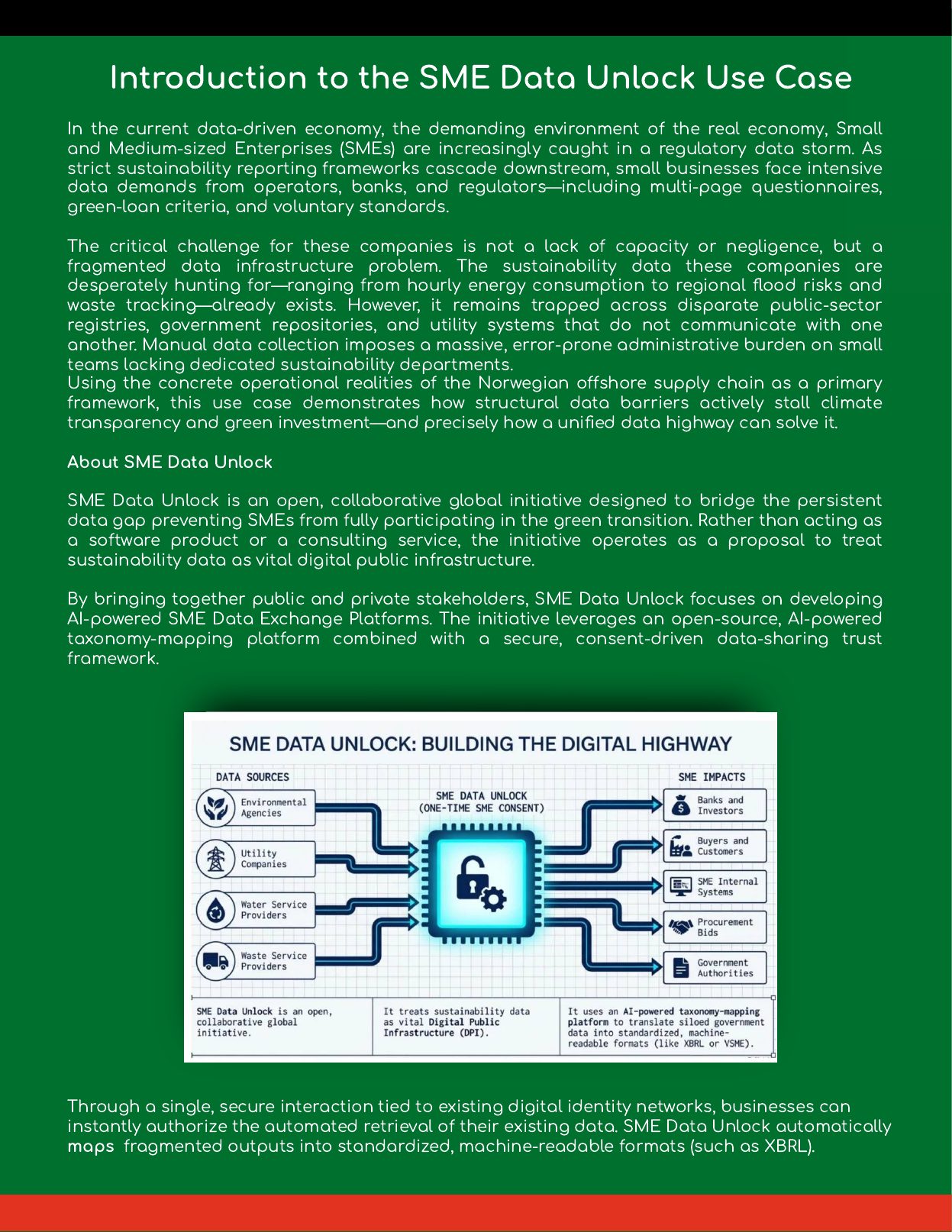
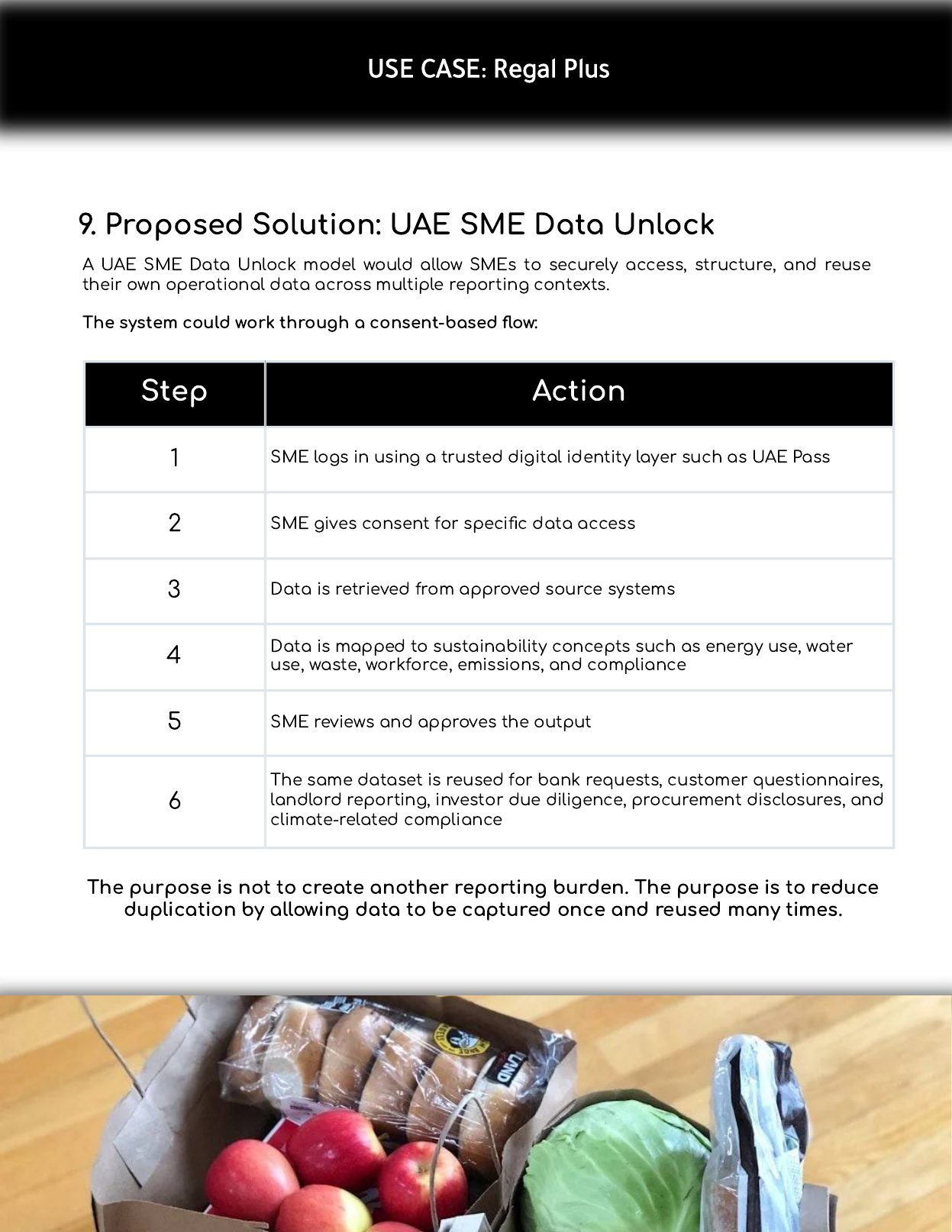
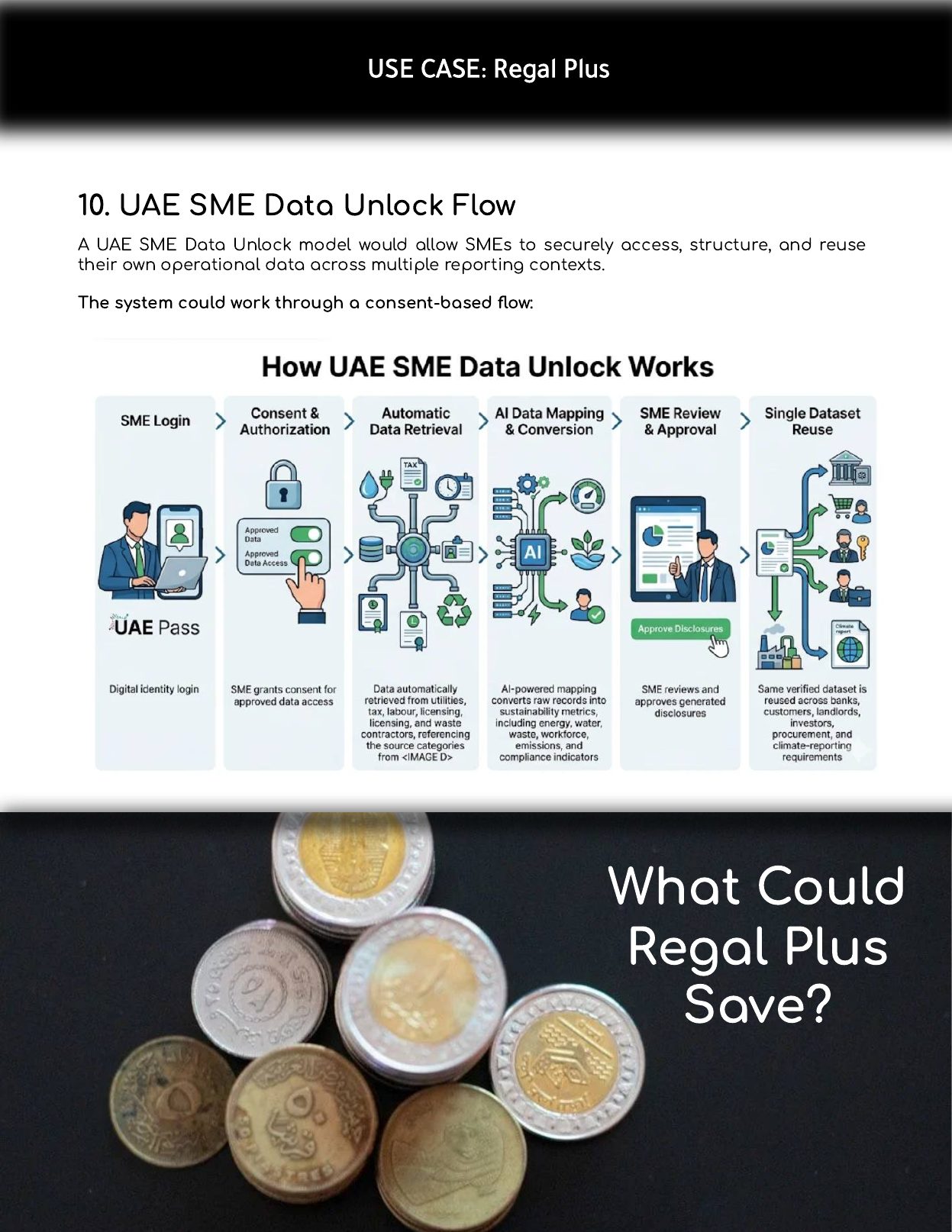
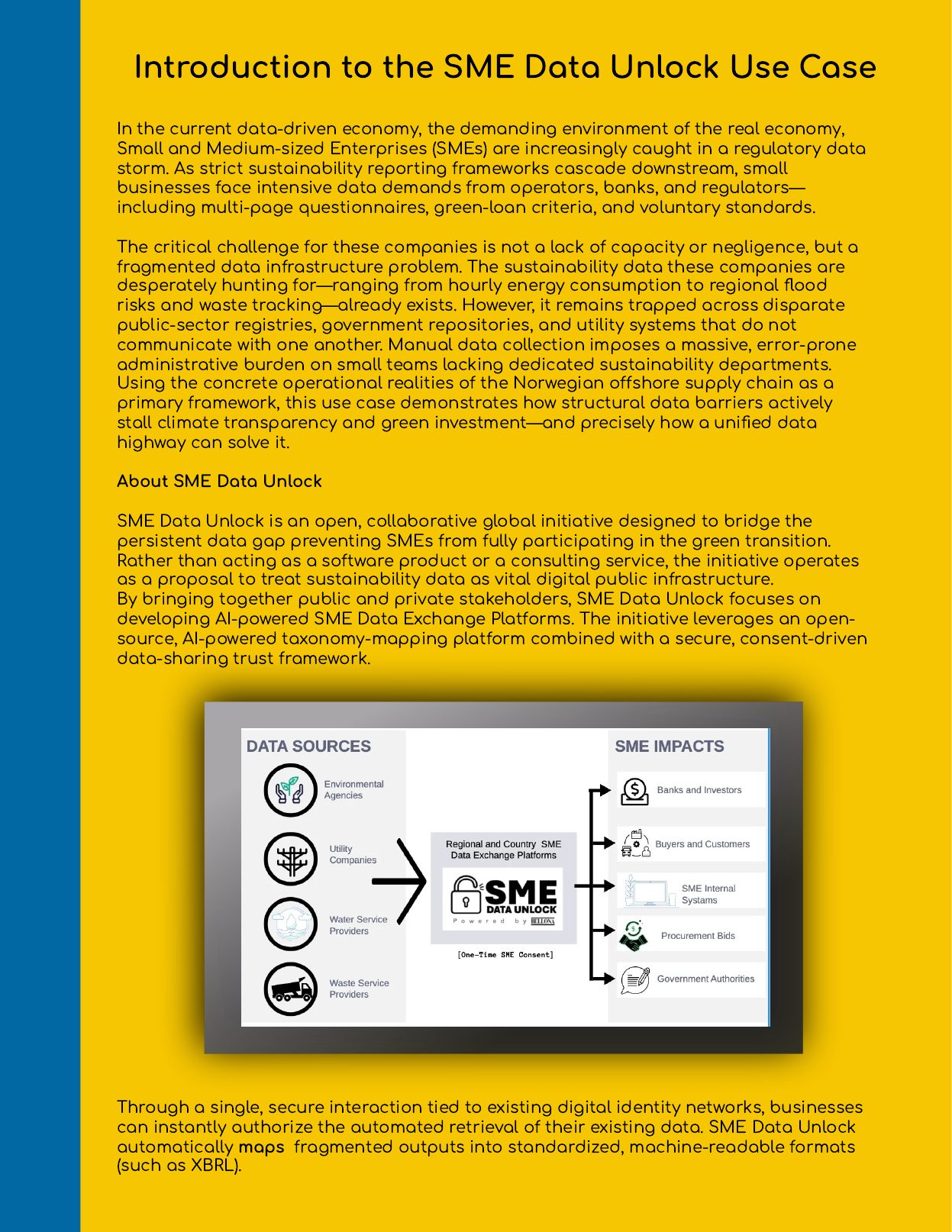
Rather than asking each business to assemble reporting data from scratch, government-supported Data Exchange Platforms retrieve it directly from the public and regulated systems that already hold it — utility companies, environmental agencies, and regulatory authorities — and convert it into machine-readable formats aligned with global standards.
The platform's code base and trust framework are released as a Digital Public Good, free for governments and institutions anywhere to adopt and adapt — with a deliberate first focus on Emerging and Developing Economies, where the data barrier is highest and the stakes are greatest.
What SMEs Get
Access, not paperwork.
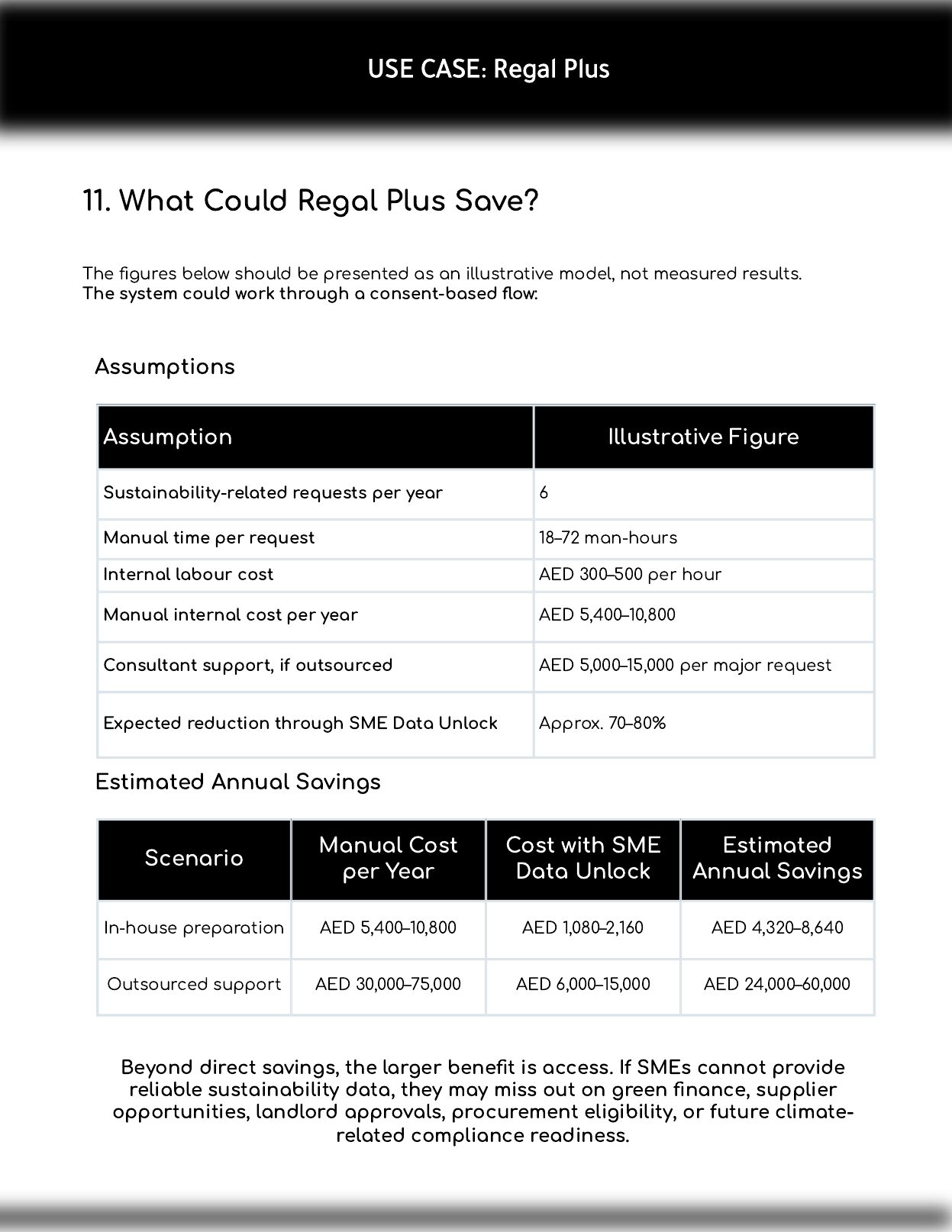
Lower cost, less burden
Automated retrieval replaces the manual scramble to answer every buyer's and regulator's reporting request in its own format.
Capital starts moving
Verified data unlocks grants, loans, and financing for energy efficiency, renewables, and clean transport — and keeps SMEs inside global supply chains.
Contracts within reach
Where climate and sustainability data now factor into procurement decisions, SMEs can finally show up with the evidence to compete for them.
See how the platform works
From one-time consent to a finance-ready report — explore the four-step model behind SME Data Unlock.
Thank you to the Bon Conseil team for their generous pro bono support in designing this site.
Why Now
Regulation moved faster than infrastructure — and SMEs are the ones absorbing the gap.
Global Drivers
This isn't a motivation problem. SMEs want to participate in the green economy — and increasingly have no choice but to try. The barriers are structural:
Data Infrastructure Gap
SMEs lack automated, low-burden tools to collect, verify, and share the sustainability data that global financial systems and supply chains now demand.
Regulatory Pressure
Frameworks like the EU's CSRD, CBAM, SEEA, and EPR cascade reporting obligations down to LMIC SME suppliers, creating immediate risk of market exclusion.
Data Fragmentation
Utility, GHG, and environmental data sits in siloed systems, with no unified, machine-readable layer connecting performance to compliance.
Absent Infrastructure
Existing standards define what the data should look like, but not how it gets collected, verified, or delivered affordably. No open platform serves SMEs at this scale — anywhere.
Use cases — regions:
Why This Matters Now
Sustainability data demands are converging on SMEs from every direction. Small and medium enterprises account for around 90% of businesses worldwide, and a major share of employment and growth — yet they are the least equipped to absorb repeated, bespoke sustainability reporting burdens.
| Driver | What it demands |
|---|---|
| CSRD and ESRS requirements, including value chain, product passports, and Scope 3 data | |
| Detailed ESG information required to remain inside supply chains | |
| Evidence required for green lending and sustainable finance | |
| Data-heavy eligibility criteria under product passport regimes |
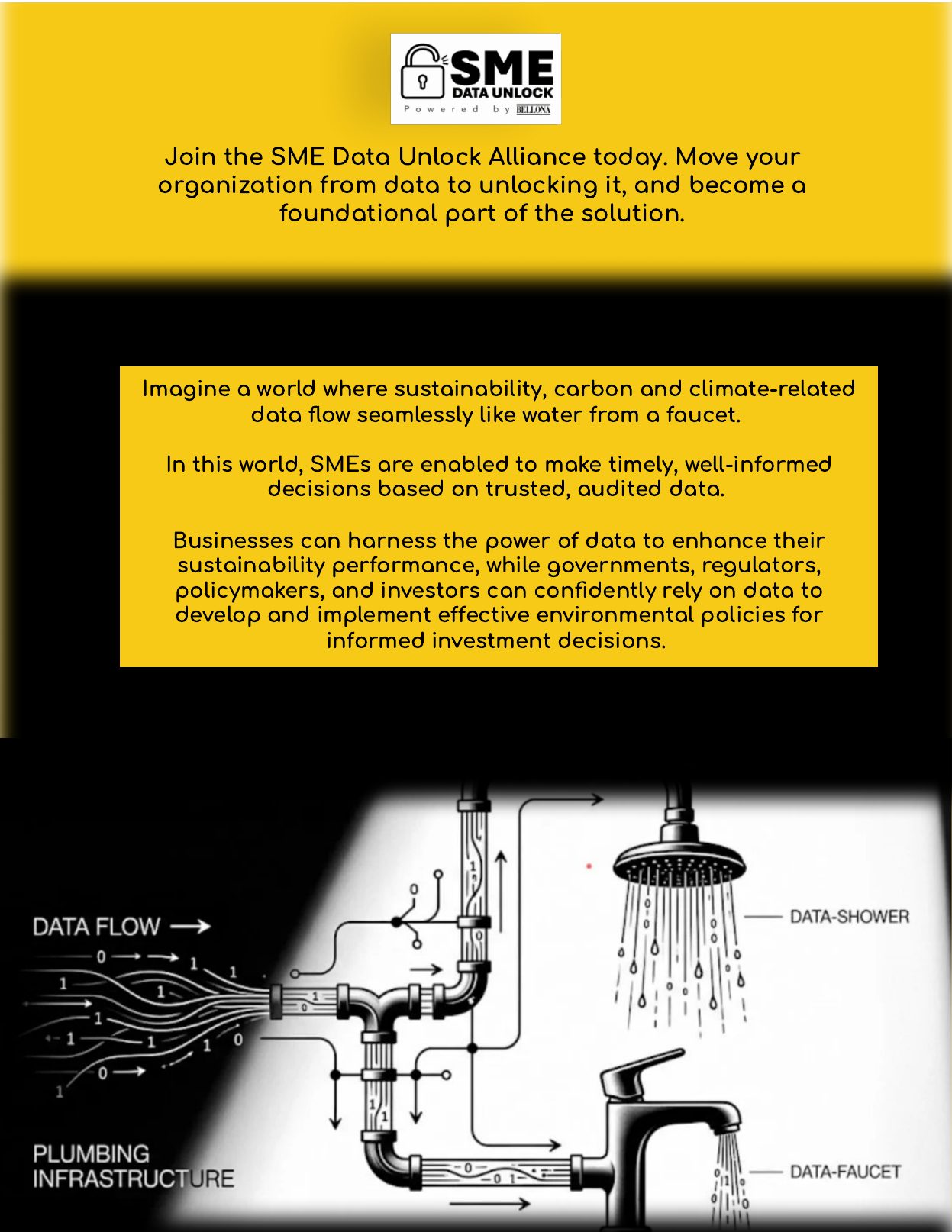
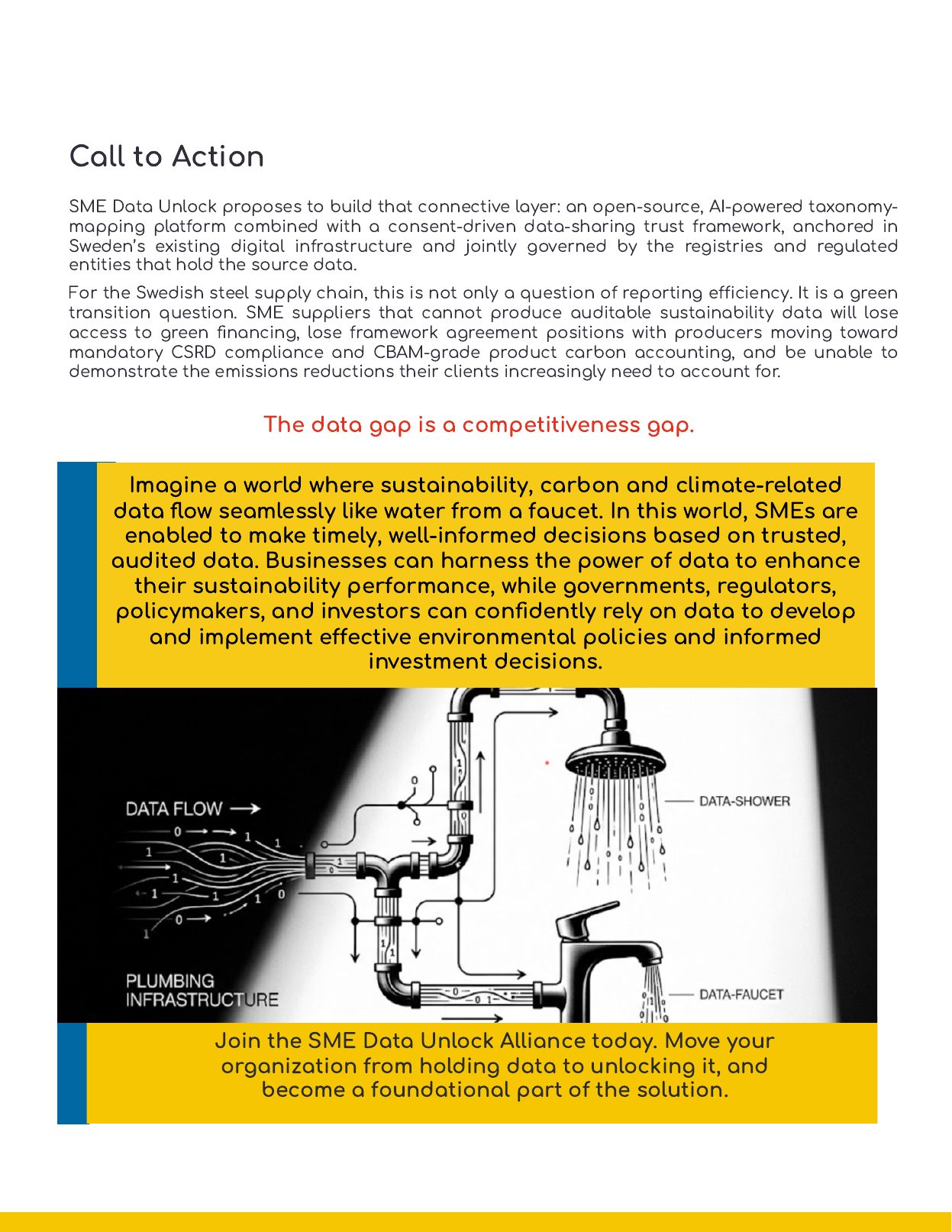
The same underlying data — energy use, water, waste, emissions — is already held in authoritative public and regulated systems, and is being requested of SMEs repeatedly, from four directions at once. If clean water can reach every business through shared pipes and standards, sustainability data should too.
Letter from the Founders
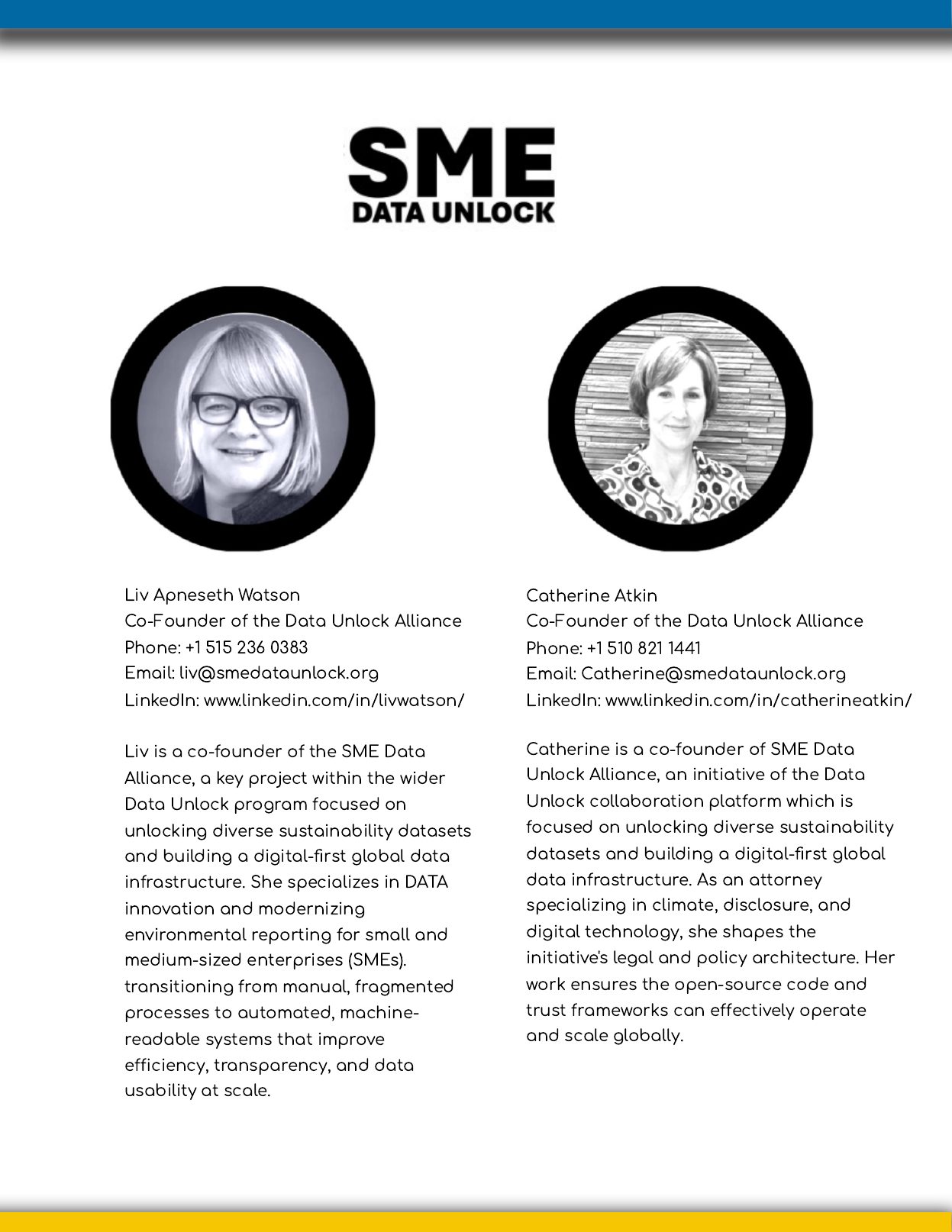
By Liv Apneseth Watson and Catherine Atkin, Co-Founders, SME Data Unlock
Over the past few years, we have engaged with global thought leaders, government leaders, open data experts, scientists, and businesses of all sizes to explore how open-source infrastructure solutions can support Small and Medium Enterprises (SMEs) across the world. Specifically, we are focused on developing open-source APIs that leverage existing data, much of it already sitting in public registries that is often collected once and never reused. Increasingly, this data is subject to emerging global regulatory mandates aimed at significantly reducing the reporting burden on SMEs in the data-driven green transition and circular economy.
We believe SME Data Unlock is one of the most important open-source infrastructure solutions for the green transition, not because it introduces something new, but because it stops us from asking SMEs to produce something that, in large part, already exists.
Across Europe and beyond, small and medium enterprises are being asked to report on sustainability, emissions, and supply chain impacts under frameworks like CSRD, VSME, and CBAM, often for the first time and without the staff or systems that larger companies take for granted. For a small manufacturer in Montenegro or a family-owned bakery in Norway, this can mean weeks of manual work chasing figures that a government registry, a utility provider, or a customs authority already holds. The burden isn't the reporting requirement itself, it's the redundancy. Every additional form, every duplicated data request, quietly weighs against the very SMEs that the green transition most needs to bring along.
Our combined experience in global open-standard development, climate-policy implementation, and cross-sector data governance has taught us that infrastructure choices shape participation. When reporting systems privilege organizations with dedicated ESG teams and costly compliance stacks, they hard-code exclusion into the transition. A truly green transition requires infrastructure that lowers barriers, aligns with authoritative data sources, and distributes trust rather than concentrating it.
SME Data Unlock exists to change that calculus. Our architecture is simple to describe and hard-won in practice: capture once, reuse many times. Instead of asking an SME to re-key data it has already reported elsewhere, our open-source infrastructure pulls from existing public registries and consent-based sources, structures it using open standards like XBRL, and makes it available for whatever is needed: sustainability disclosure, a financing application, or a supply chain request. No SME should have to prove the same data point twice.
This only works as open, public-good infrastructure. A green transition built on proprietary, walled-off data platforms will always privilege those who can afford access. We have chosen instead to build with a founding alliance of mission-driven partners including our host The Bellona Foundation, XBRL International, and the Adria Future Foundation to prove the model with real SMEs, in real markets.
We are under no illusion that this is easy. Regulatory landscapes are fragmented, registries don't talk to one another, and trust in data infrastructure has to be earned, jurisdiction by jurisdiction, institution by institution. But we have also seen what's possible when open standards and open data infrastructure are allowed to work in the background as machine-readable financial reporting went from a niche idea to a global norm underpinning capital markets today.
We invite stakeholders - governments, development finance institutions, standard-setters, and SMEs themselves - to build this with us. The green transition will not be won by asking small businesses to do more with less. It will be won by giving SMEs access to their data.
Liv Apneseth Watson & Catherine Atkin
Co-Founders, SME Data Unlock
Meet the Team
Role
Liv A. Watson
Co-Founder
Tap to read bioLiv A. Watson
Co-founder, SME Data Unlock. Co-founder of XBRL International and the Global Digital Single Market Data Alliance; Senior Fellow, Data Foundation & Bellona Foundation. 25+ years advancing financial and sustainability reporting standards, including leadership roles at Workiva; author, XBRL for Dummies and The Governance, Risk and Compliance Handbook.
LinkedIn ↗Catherine Atkin
Co-Founder
Tap to read bioCatherine Atkin
Co-founder, SME Data Unlock. Climate attorney and Stanford CodeX Fellow; co-founder of the Global Digital Single Market Data Alliance; Senior Fellow, Bellona Foundation.
LinkedIn ↗Jon Apneseth
Team
Tap to read bioJon Apneseth
[Role / bio to be added]
LinkedIn: [add URL]Dag Drevvatne
Team
Tap to read bioDag Drevvatne
[Role / bio to be added]
LinkedIn: [add URL]Biljana Braithwaite
Regional Lead
Tap to read bioBiljana Braithwaite
Regional Lead, Western Balkans.
LinkedIn: [add URL]Goran
Regional Lead
Tap to read bioGoran
Regional Lead, Western Balkans.
LinkedIn: [add URL]Urmish Mehta
Regional Lead
Tap to read bioUrmish Mehta
Regional Lead, MENA Region. Sustainability and Business Transformation Expert.
LinkedIn ↗Tanuj Agarwal
Regional Lead
Tap to read bioMark Brits
Advisor
Tap to read bioWilliam Gee
Advisor
Tap to read bioWilliam Gee
[Role / bio to be added]
LinkedIn: [add URL]Jane Diplock
Advisor
Tap to read bioJane Diplock
Chair of the Global Reporting Initiative Supervisory Board; former Chair of IOSCO.
LinkedIn ↗Eugene Montoya
Advisor
Tap to read bioEugene Montoya
Climate risk and sustainable finance professional; board member and Treasurer of the Waterfront Alliance.
LinkedIn ↗Chris Dreyer
Advisor
Tap to read bioChris Dreyer
[Role / bio to be added]
LinkedIn: [add URL]Cathrine Armour
Advisor
Tap to read bioCathrine Armour
Global Director of Data Initiatives at the Taskforce on Nature-related Financial Disclosures (TNFD).
LinkedIn ↗Katherine Foster
Advisor
Tap to read bioKatherine Foster
Strategy Advisor at The Digital Economist and former Chief Intelligence Officer of the Green Digital Finance Alliance.
LinkedIn ↗The Solution
Government-Backed SME Data Exchange Platforms
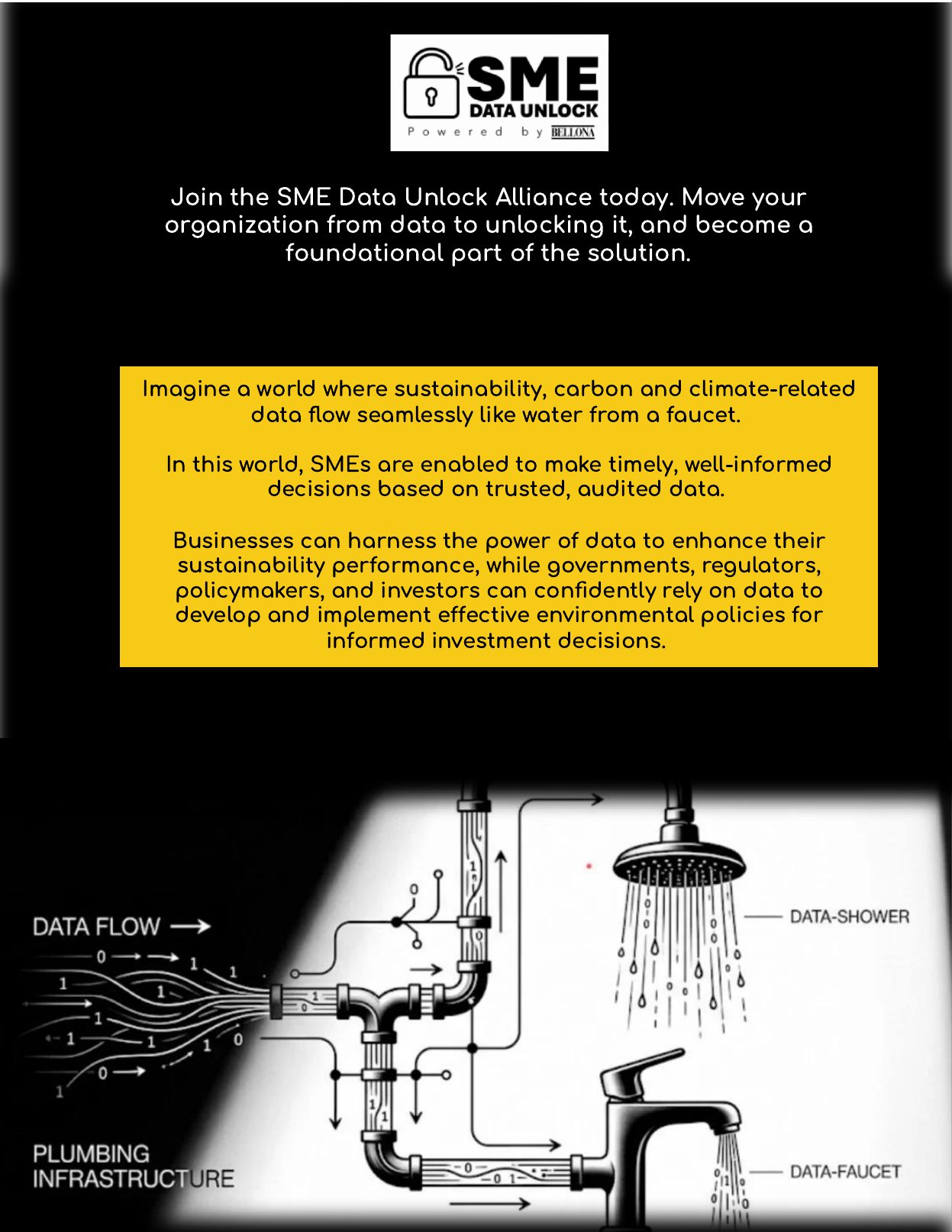
Open-source APIs expose authoritative data through standardized, interoperable interfaces that map directly to SME reporting schemas, so firms no longer need to manually rebuild information already stored across regulatory, banking, and utility systems.
Connect at source
Authoritative data, accessed directly. Utilities, water authorities, environmental agencies, and other public systems are made accessible through secure, open-source APIs.
Consent-based access
SMEs decide who sees their data — regulators, banks, customers, or partners — and control how it's reused.
Structured & interoperable
Data is converted into machine-readable formats aligned with global digital reporting standards, including XBRL and EFRAG's SME sustainability standards.
Collect once, use many
One trusted dataset is reused across multiple reporting requirements, cutting cost and complexity at the source.
Built as a Digital Public Good: the standardized codebase and trust frameworks behind these platforms are developed open source, for adaptation across both emerging and developing economies and advanced economies alike — positioning Norway's digitalization leadership, and its experience with trusted infrastructure such as Altinn, as a foundation the world can build on.
How We Work
A country-tailored implementation model.
How We Work — A Country-Tailored Implementation Model
SME Data Unlock is not a one-size-fits-all blueprint. Every implementation is grounded in open standards and open source, and built with the institutions that already hold the data.
Convene a public–private consortium
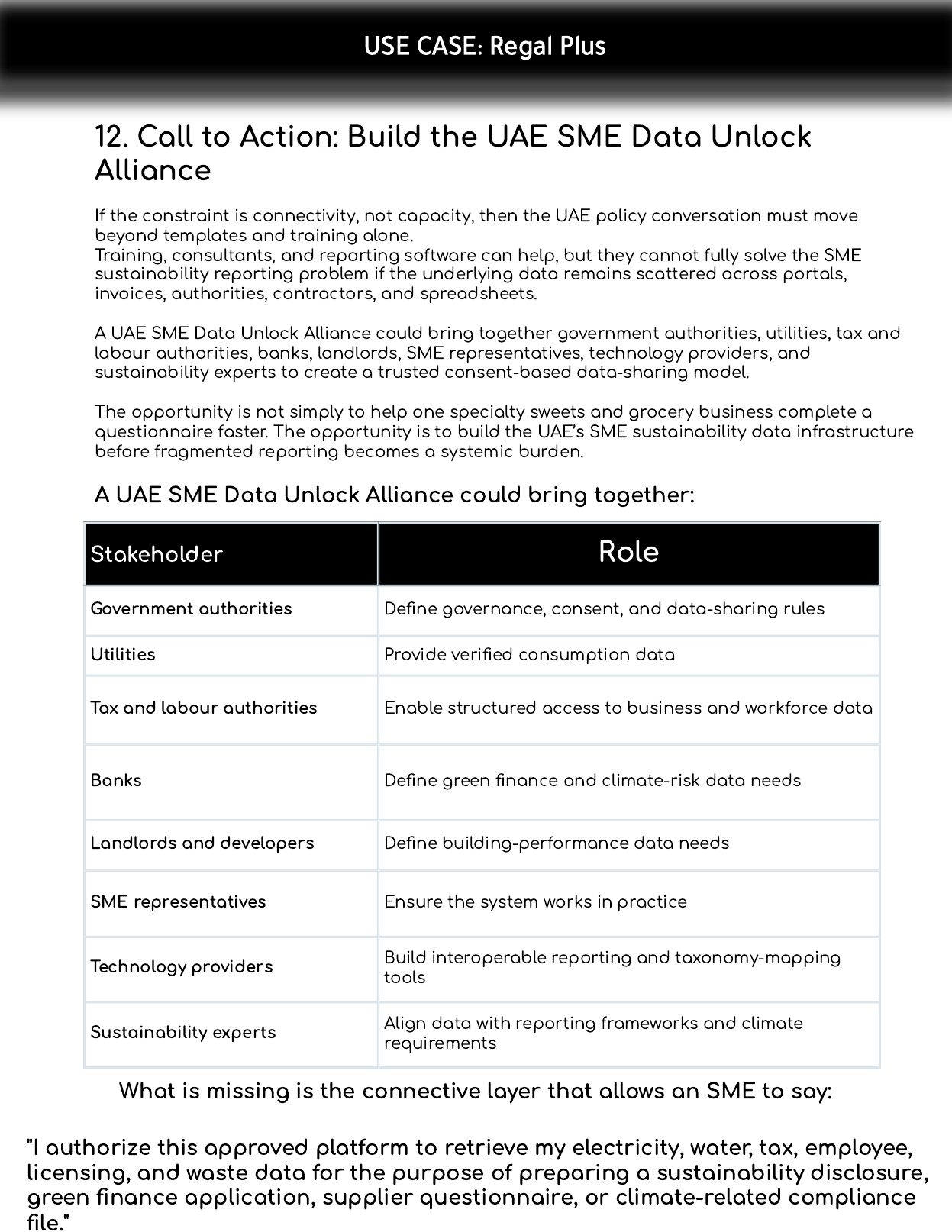
Relevant ministries, regulators, utilities, statistical offices, environmental agencies, SMEs, banks, and standards bodies are brought to the same table.
Bring in global and local experts
Specialists in sustainability reporting, XBRL, open data, and digital public infrastructure work alongside national experts to design fit-for-purpose solutions.
Co-design local Data Exchange Platforms
Architectures adapted to national legal, technical, and market contexts, while maintaining alignment with EFRAG SME standards and global interoperability.
Develop open-source, vendor-neutral infrastructure
Code, taxonomies, and trust frameworks released under open licenses, for transparency, reuse, and long-term resilience.
Pilot with real SMEs and real data
Early pilots focus on tangible use cases — green lending, supply chain reporting, procurement — so the benefits are immediate.
The SME Data Roadmap
The SME Data Roadmap
Governance and neutrality span all phases — not just Phase 1. The roadmap sets out how SME Data Unlock moves from a governance framework to a live, shared data infrastructure, in eight phases grouped into four stages.
Phase 1 — Foundation
Objective: create trust, neutrality, and legitimacy before anything gets built.
- Designate a neutral convenor — Bellona Foundation serves as the neutral facilitator, with no commercial stake in the outcome.
- Technical Scope Analysis — a formal scoping document defining what the platform will and won't cover.
- Establish a National Steering Committee across SMEs, funders, suppliers, buyers, authorities, and standards experts.
- Charter and governance set early: open-source by default, vendor-neutral, SME-first, privacy- and consent-driven.
- Initial funding, market engagement, and a feasibility study running alongside a first-country pilot prototype.
Outputs: Governance charter · Roles and decision framework · Trust and neutrality principles
Phase 2 — Public Alignment
Objective: government dialogue and support.
- Engage relevant national ministries, innovation agencies, and government bodies.
- Position the initiative as pre-competitive national infrastructure — not a vendor product.
- Secure seed funding for standards development, the pilot, and SME onboarding.
Outputs: Public backing · Seed funding · Policy alignment
Phase 3 — Use-Case Definition
Objective: establish what data actually matters.
- Run SME workshops across sectors to surface real needs.
- Identify high-friction reporting requirements and duplicate data requests.
- Prioritise financing, supplier, and sustainability use cases.
Outputs: Use-case map · SME value proposition
Phase 4 — Metadata Framework
Objective: interoperability, not duplication.
- Structured dialogue with authorities holding water, utility, statistical, and environmental data.
- Define shared metadata standards and reference models.
- Enable linking SME data directly with existing public datasets.
Outputs: Metadata principles · Reference architecture
Phase 5 — SME XBRL Taxonomy
Objective: a common SME reporting language.
- Develop an open SME XBRL taxonomy, aligned with the EFRAG XBRL SME Standard.
- Keep it modular, scalable, and appropriately scoped for SME use — not a cut-down enterprise taxonomy.
- Validate the taxonomy directly with SMEs and funders before finalizing.
Outputs: Open SME taxonomy · EFRAG alignment mapping
Phase 6 — Pilot Build
Objective: move from theory to practice.
- Build a lightweight, open reference pilot.
- Prove the "capture once, reuse many times" model with real data flows.
- Test with real SMEs, funders, and suppliers — not simulated data.
Outputs: Working pilot · Real data flows · Lessons learned
Phase 7 — Engagement
Objective: unlock capital.
- Bring banks, investors, and public funders to the table.
- Align on minimum viable datasets funders will actually accept.
- Secure commitments to reuse standardised SME data, rather than requesting bespoke formats.
Outputs: Aligned funder requirements · Reduced SME reporting burden
Phase 8 — Data Sharing
Objective: SME control and trust, at scale.
- Define consent-based data-sharing processes.
- Support sharing with both internal stakeholders and external partners.
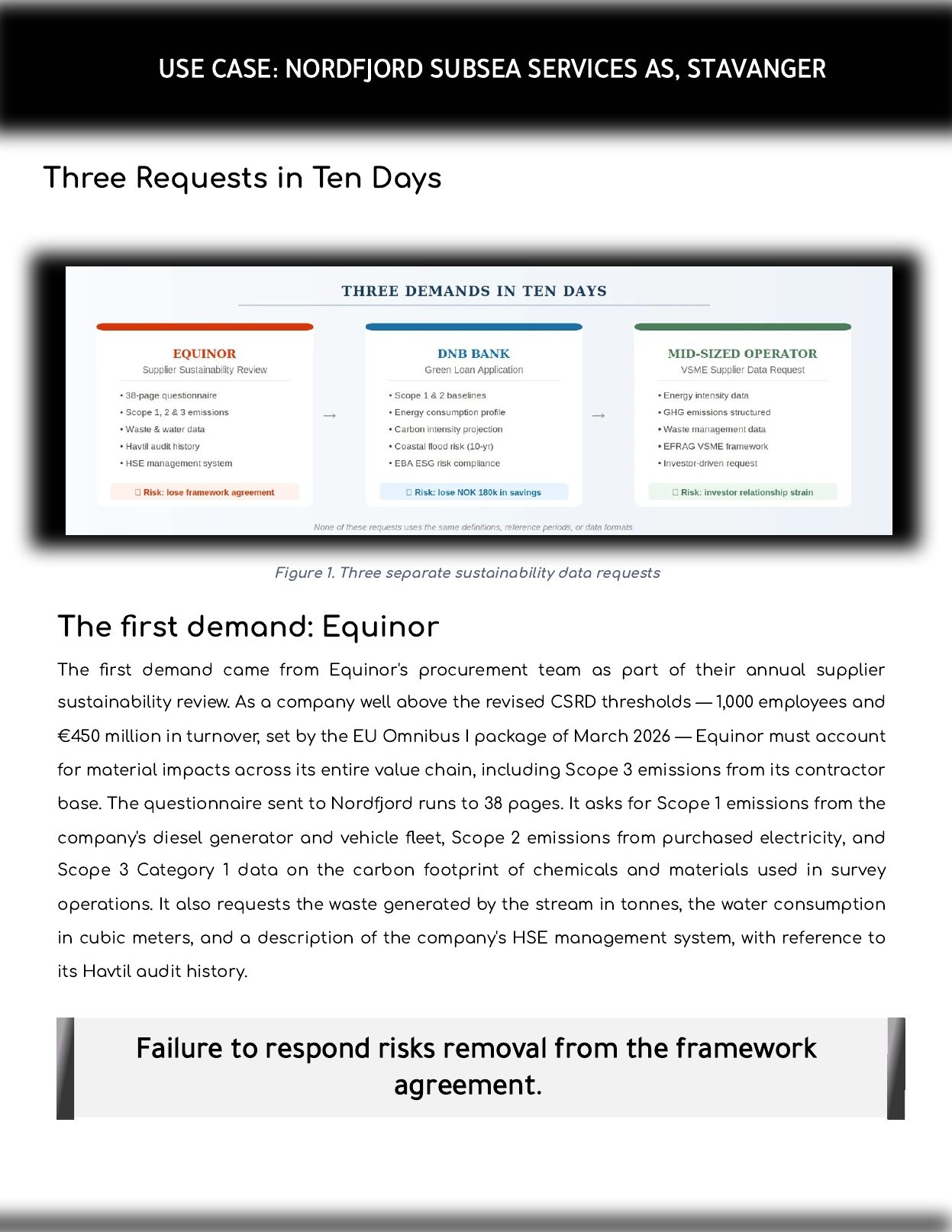
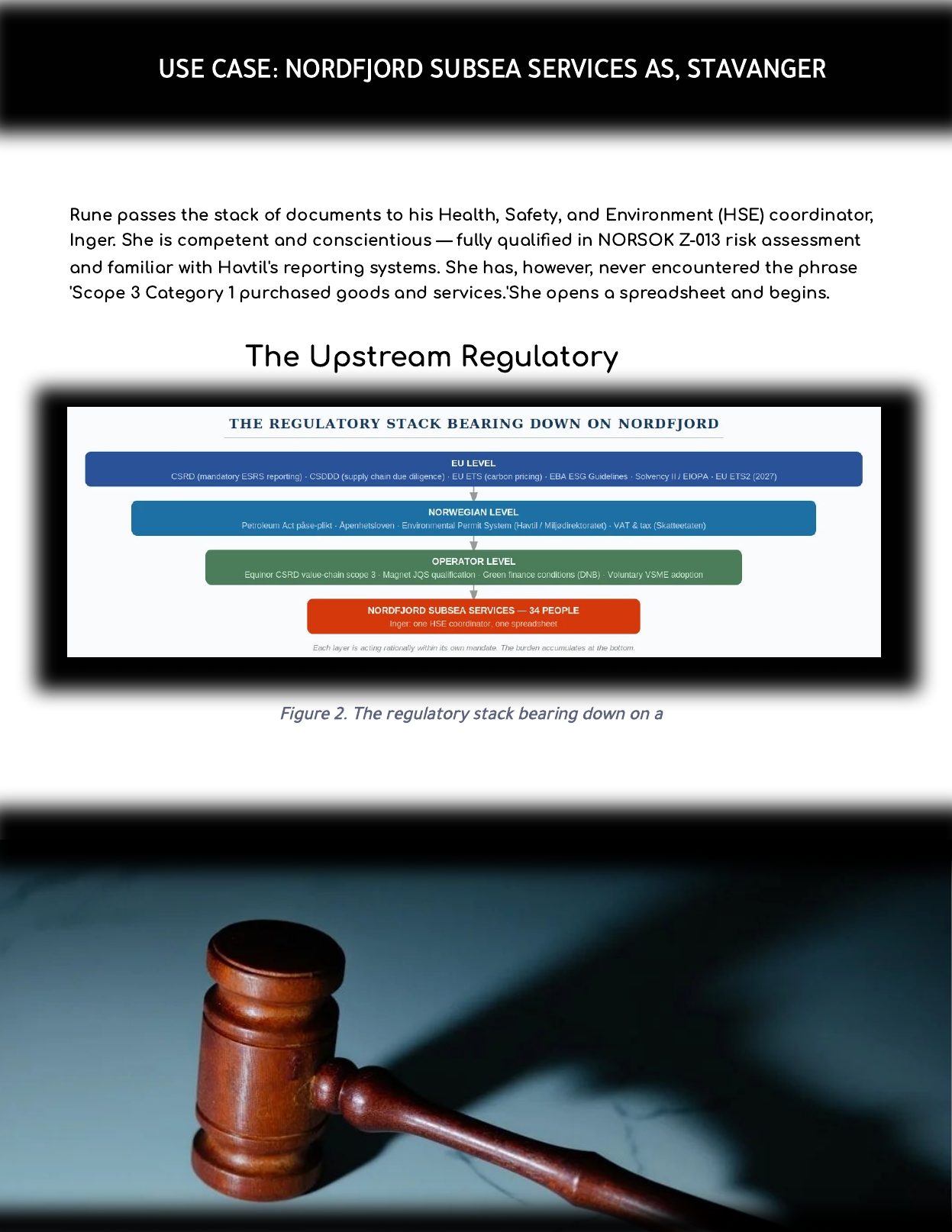
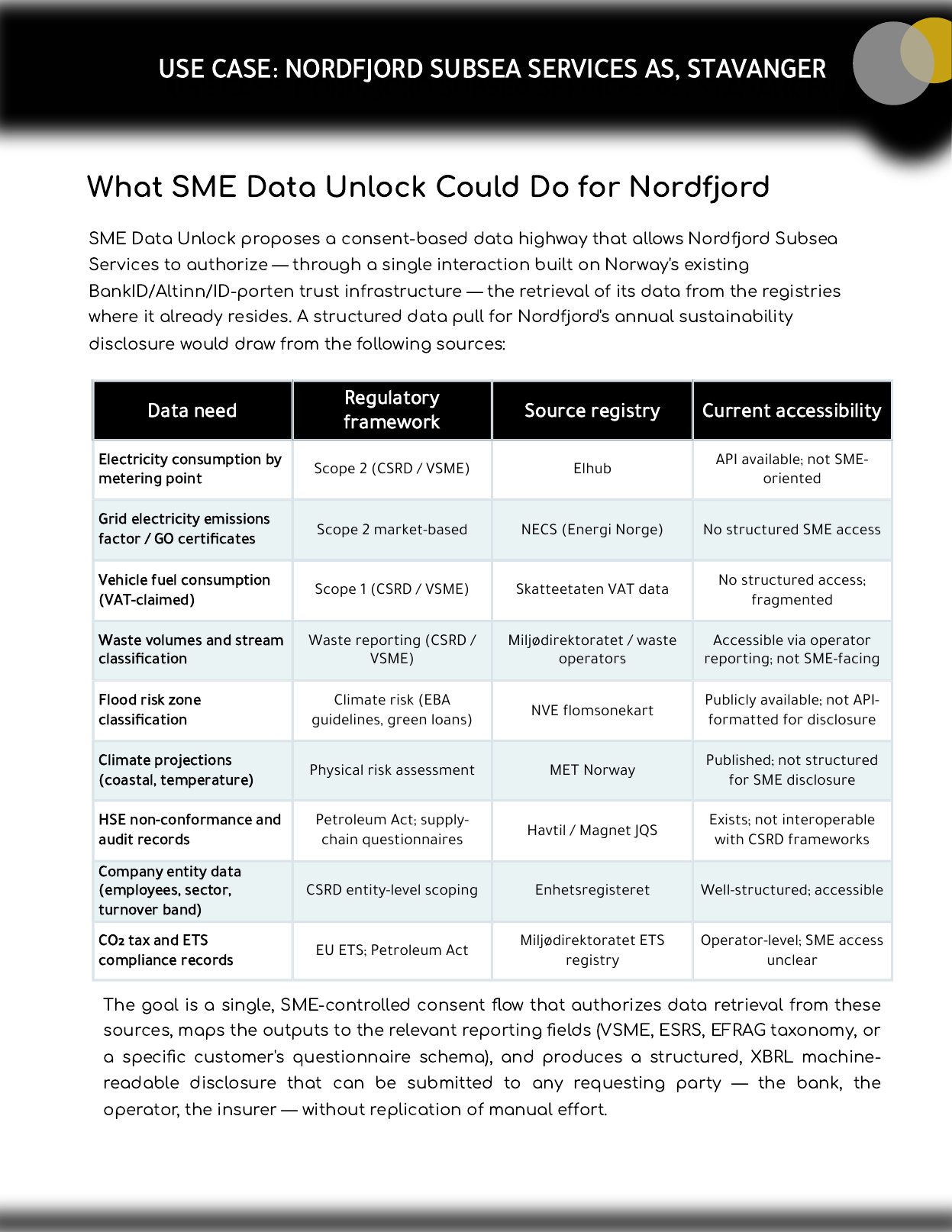
Illustrative Use Case · Nordfjord Subsea Services AS, Stavanger
Norway
“The sustainability data SMEs need already exists — they just need access to it.”
Download Full PDF ↓
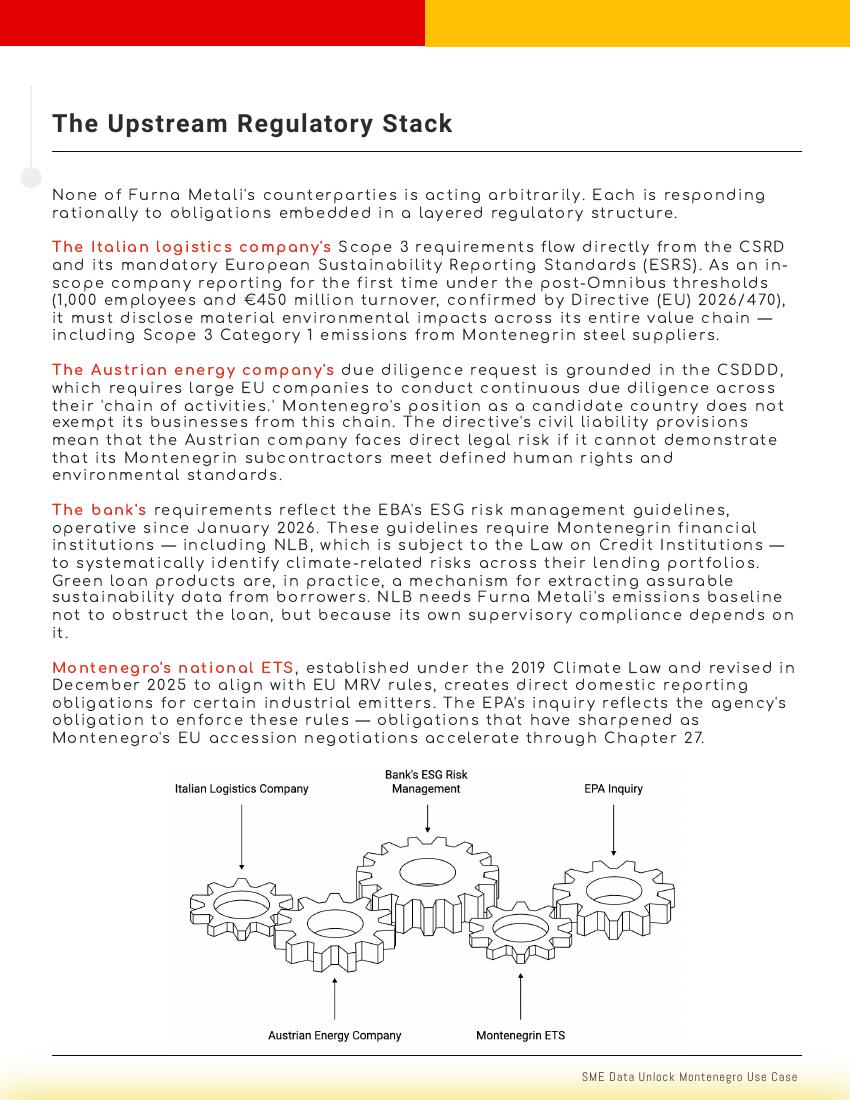
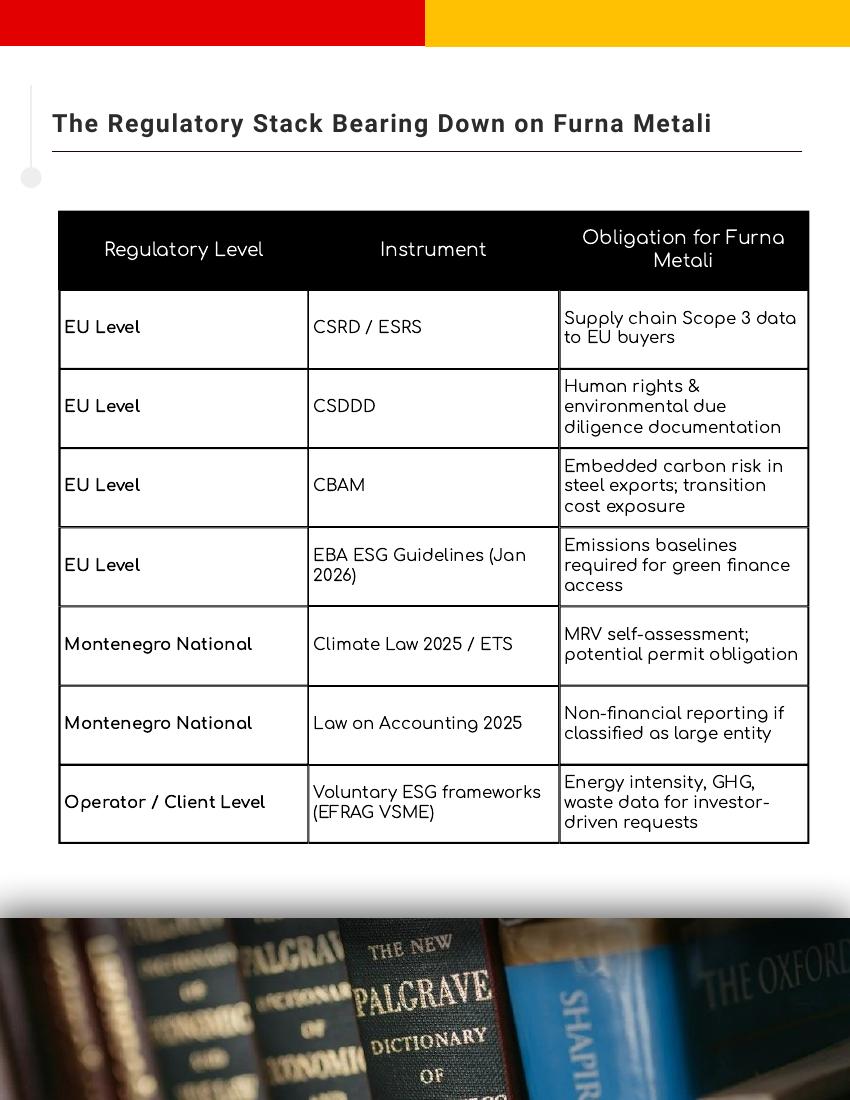
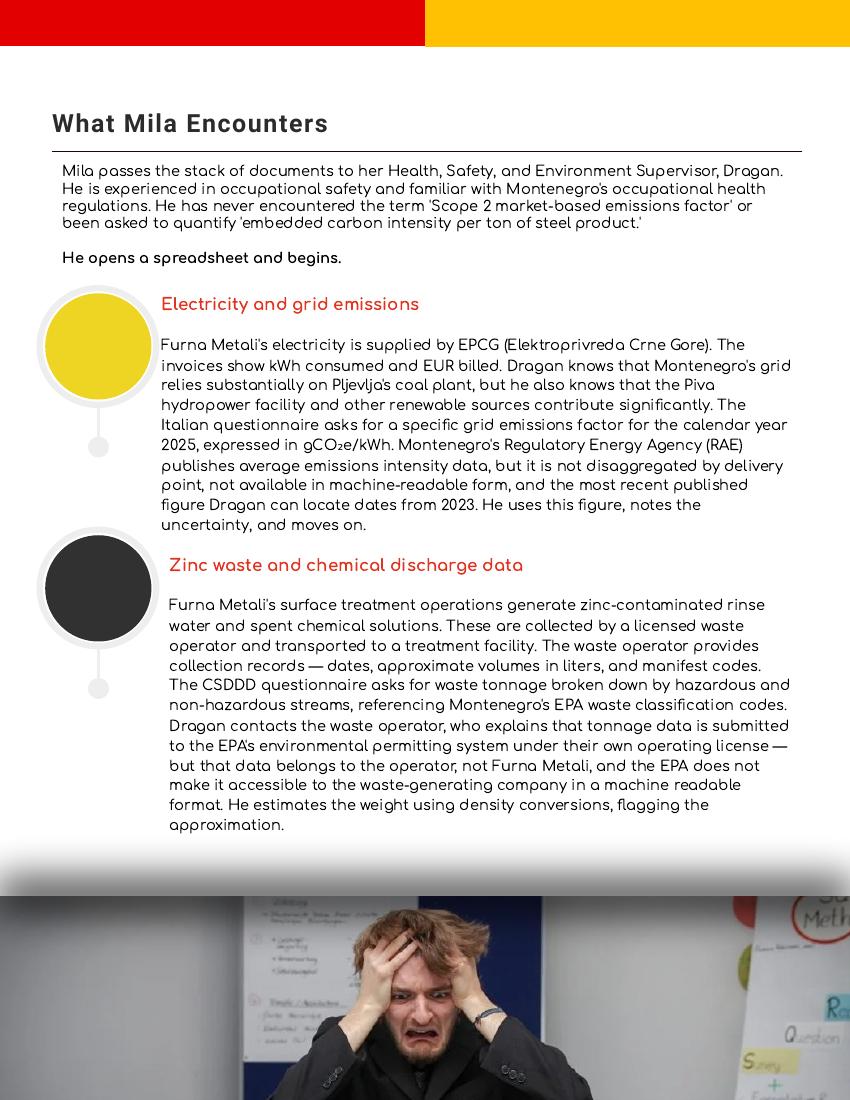
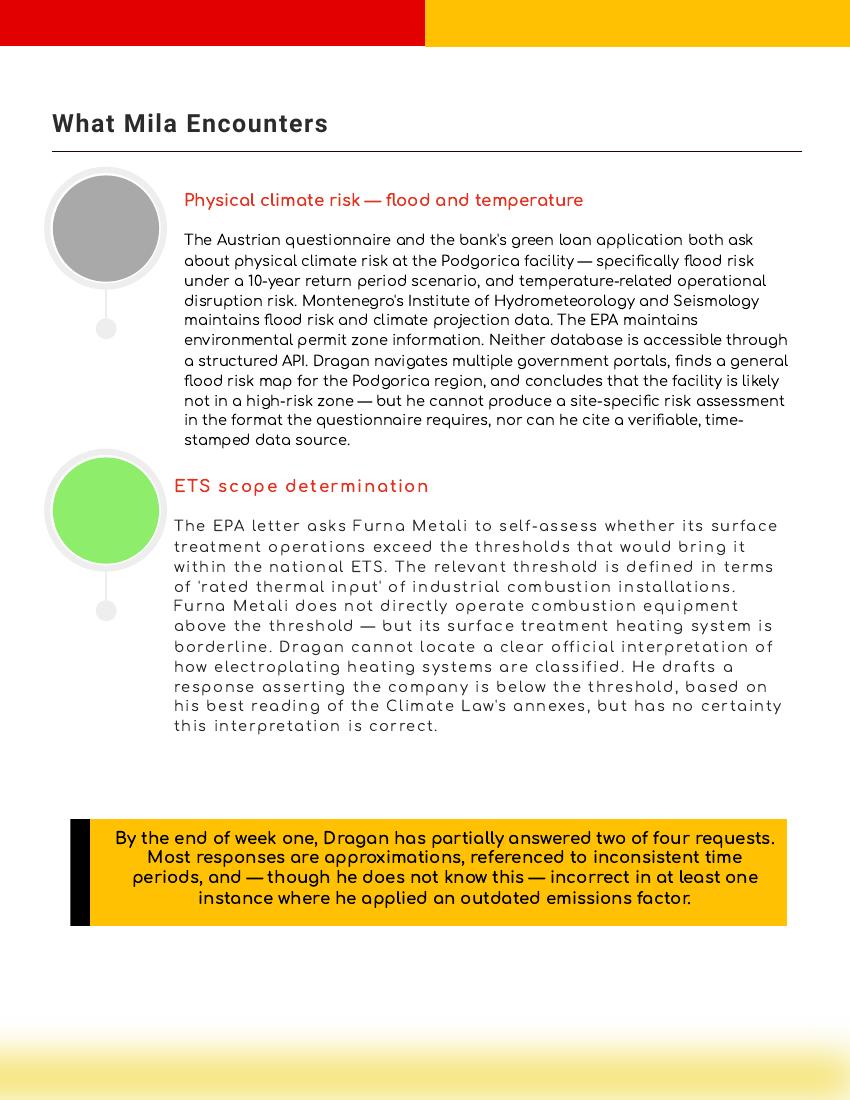
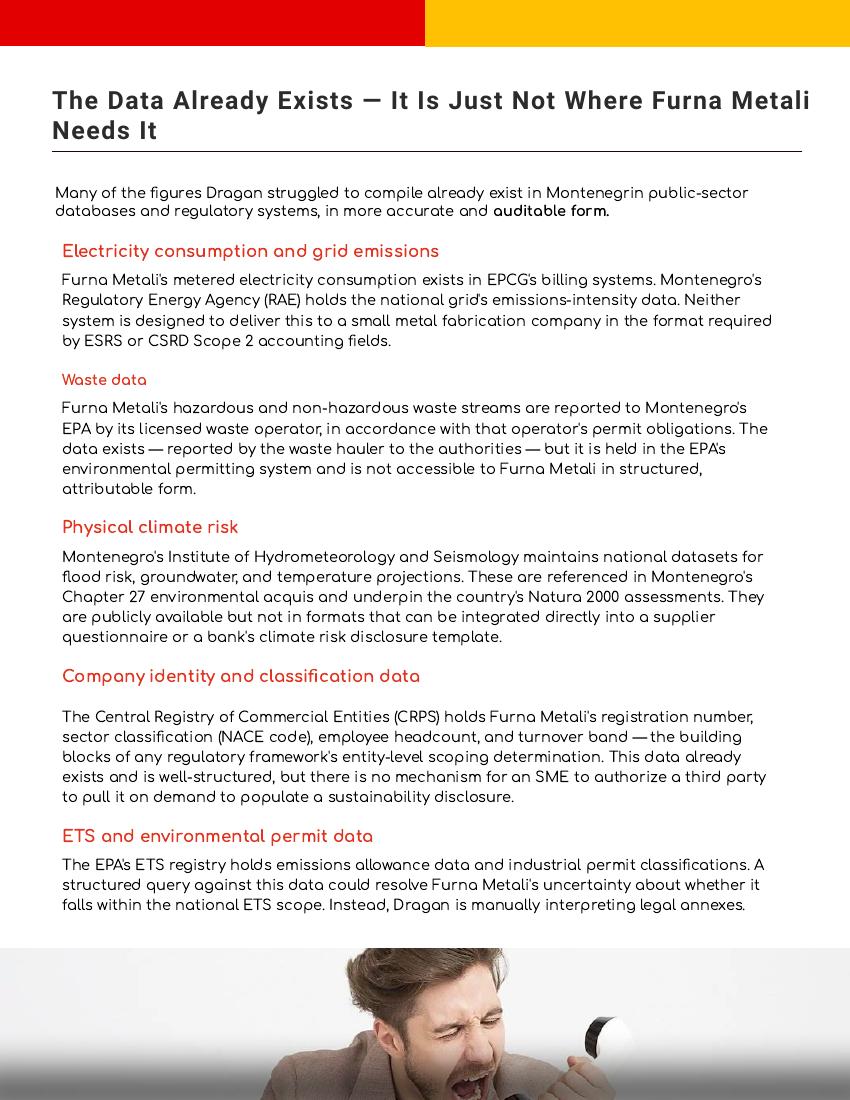
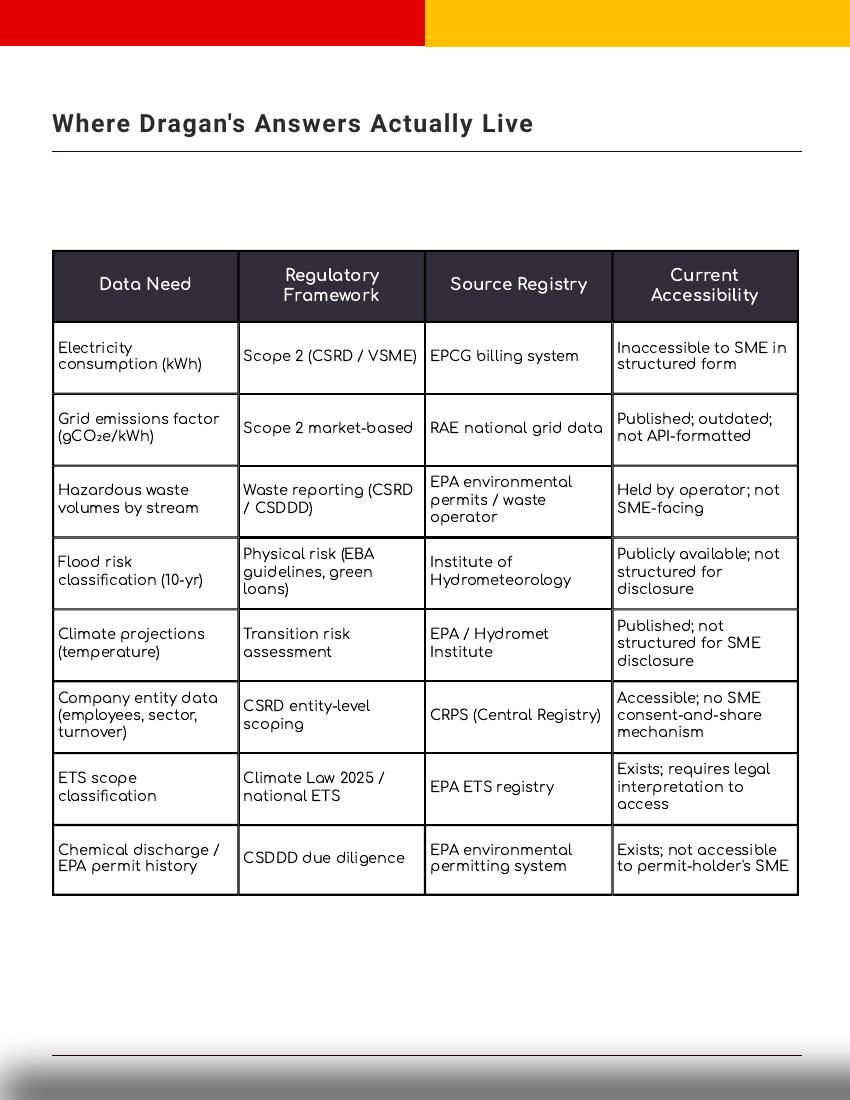
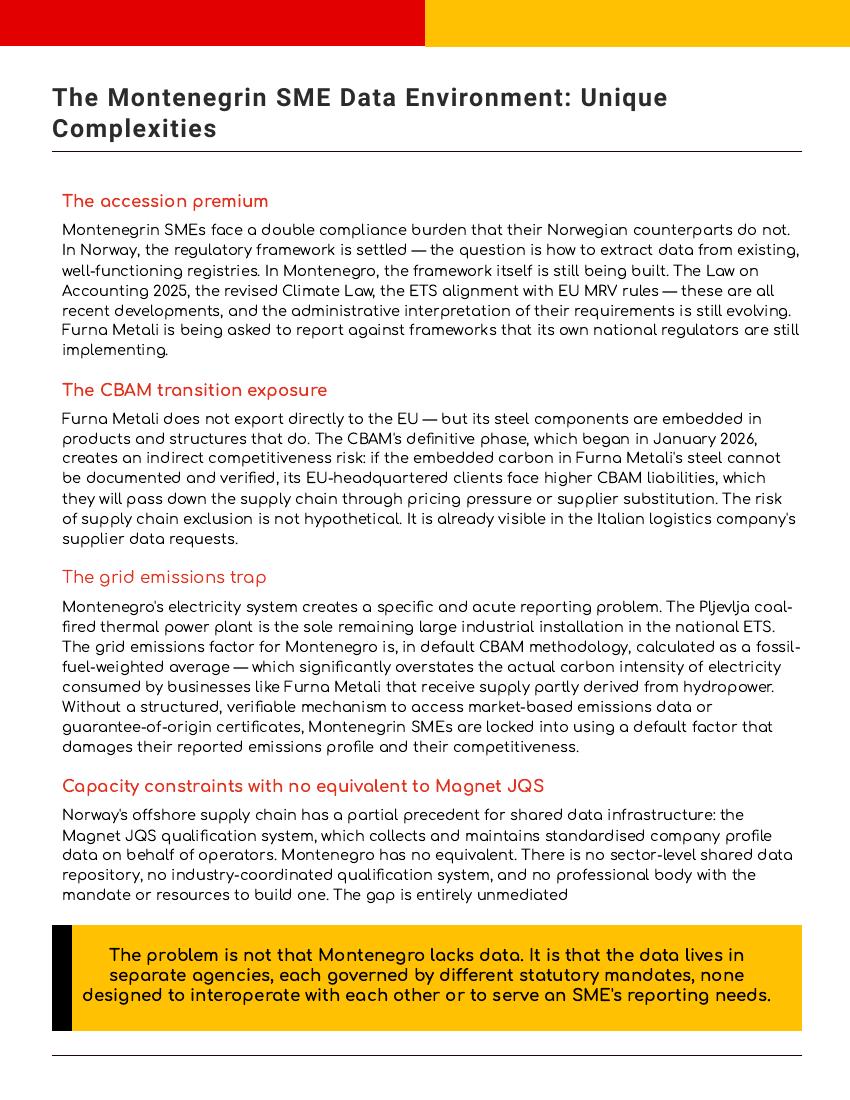
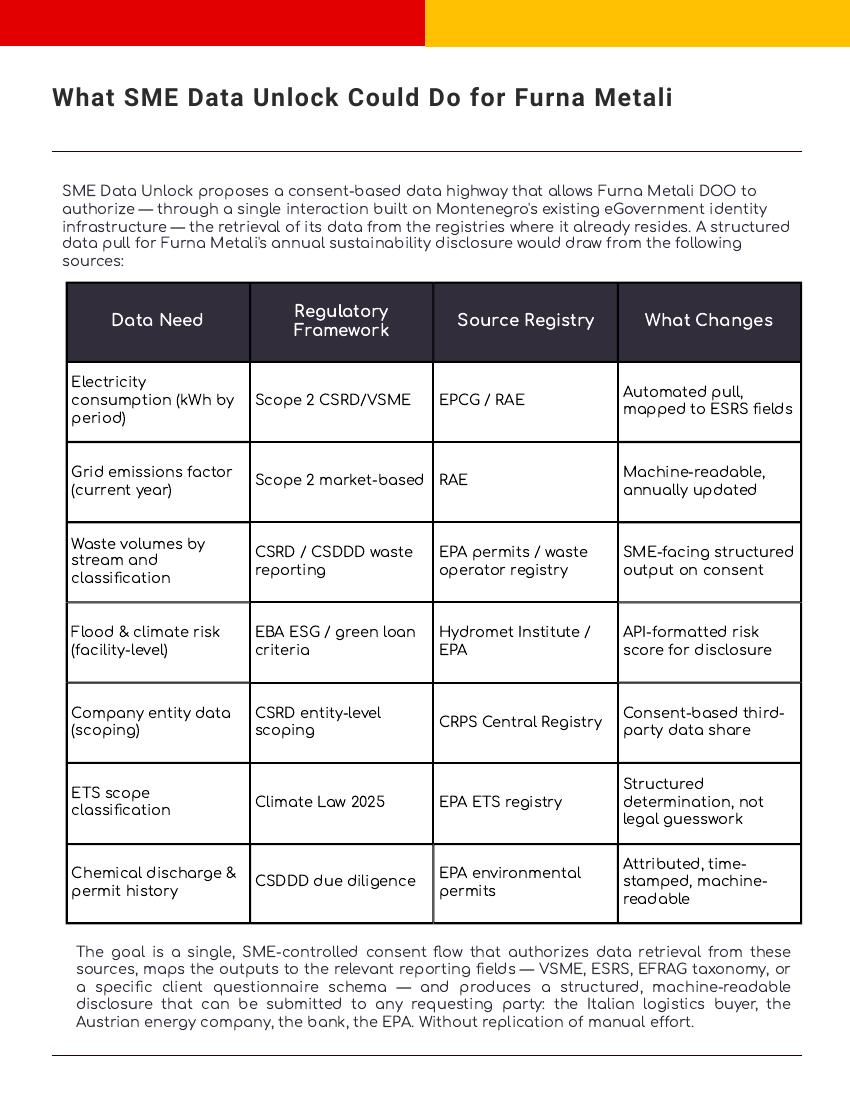
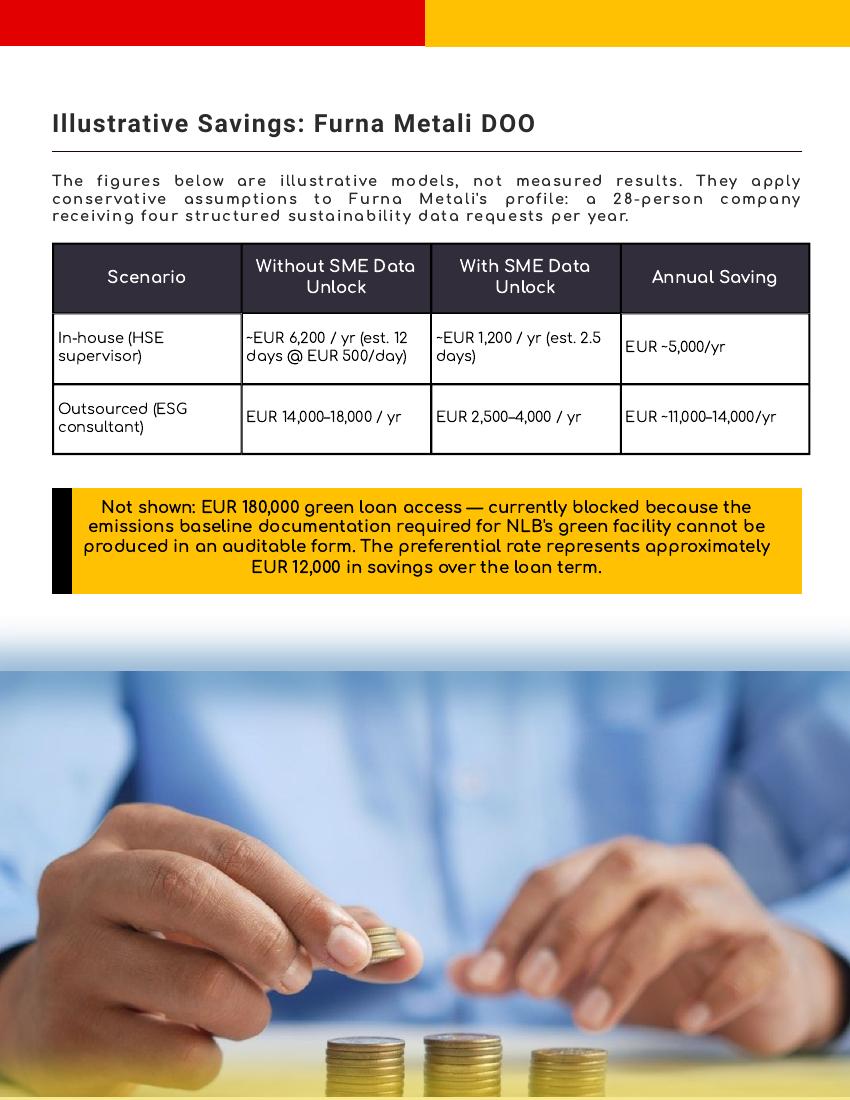
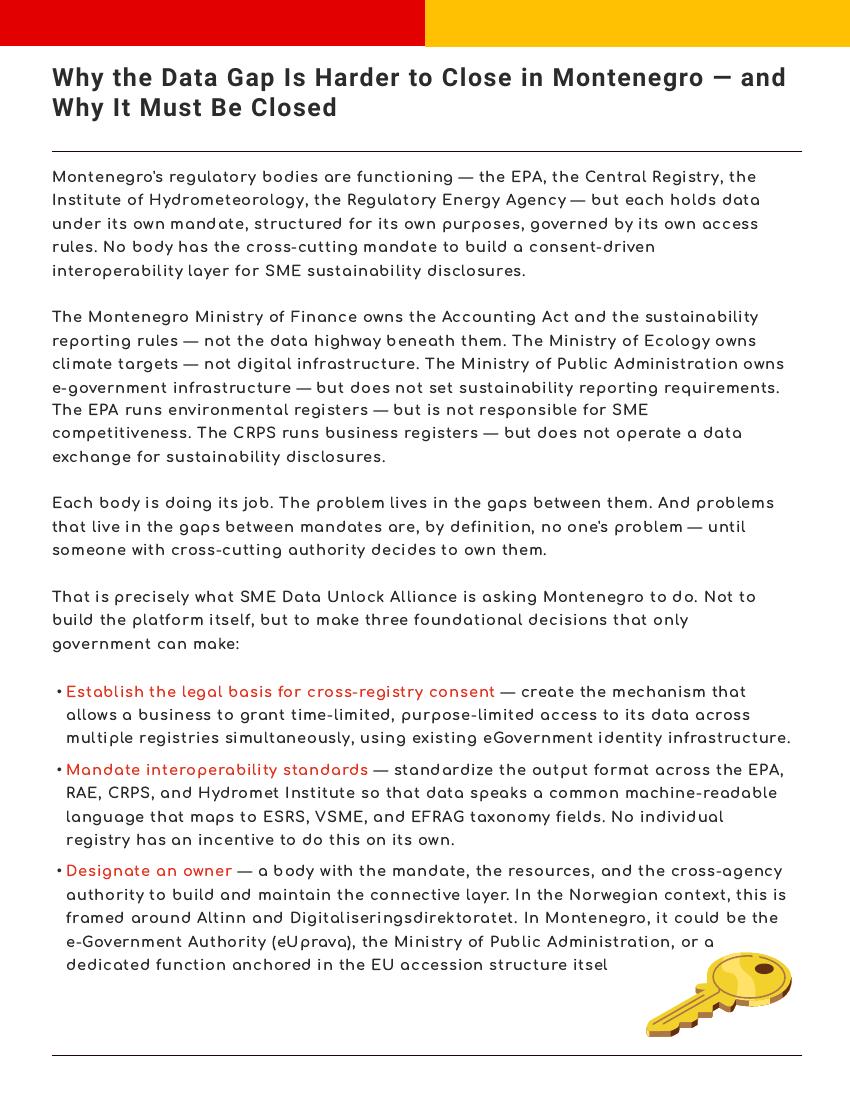
Illustrative Use Case · Furna Metali DOO, Podgorica
Montenegro
“The sustainability data SMEs need already exists — they just need access to it.”
Download Full PDF ↓
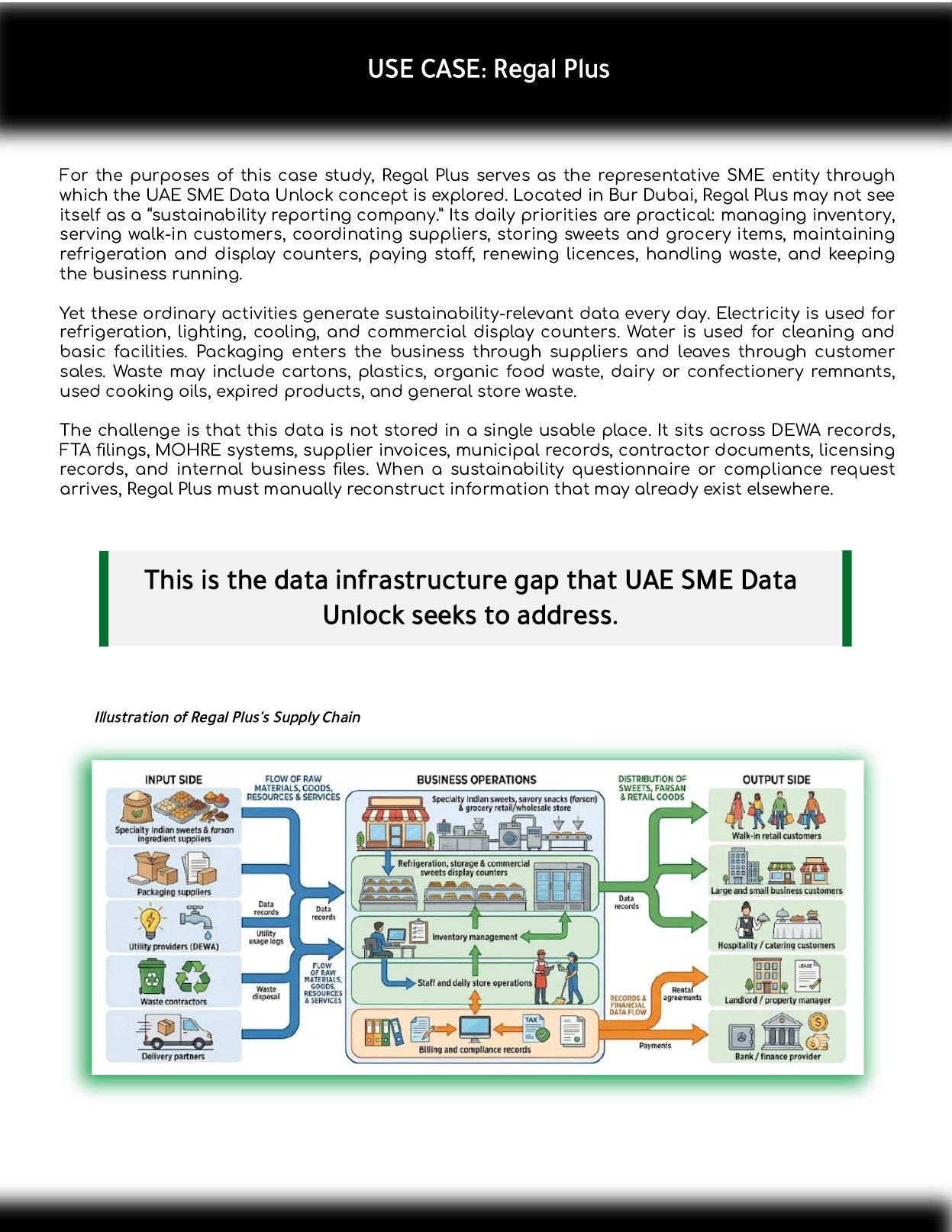
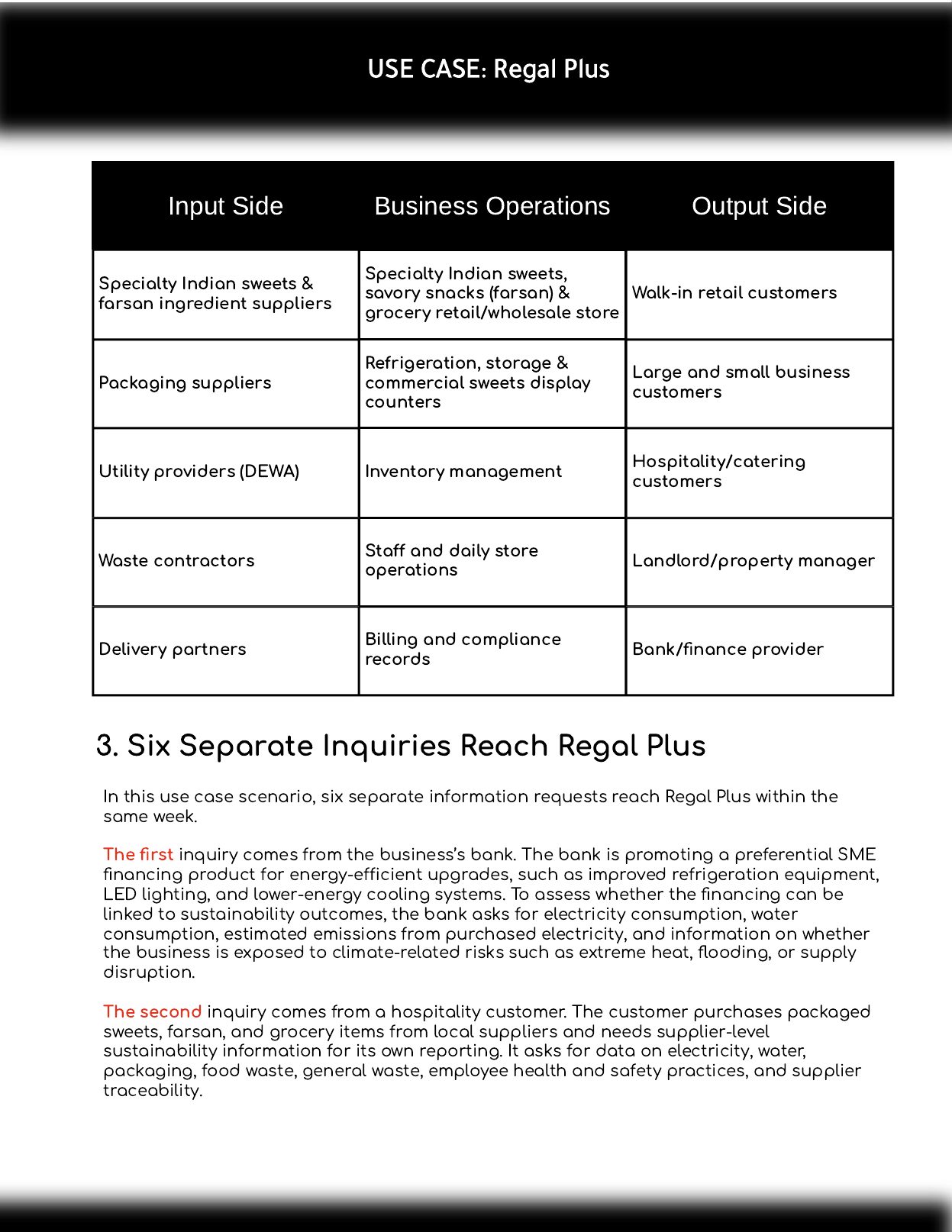
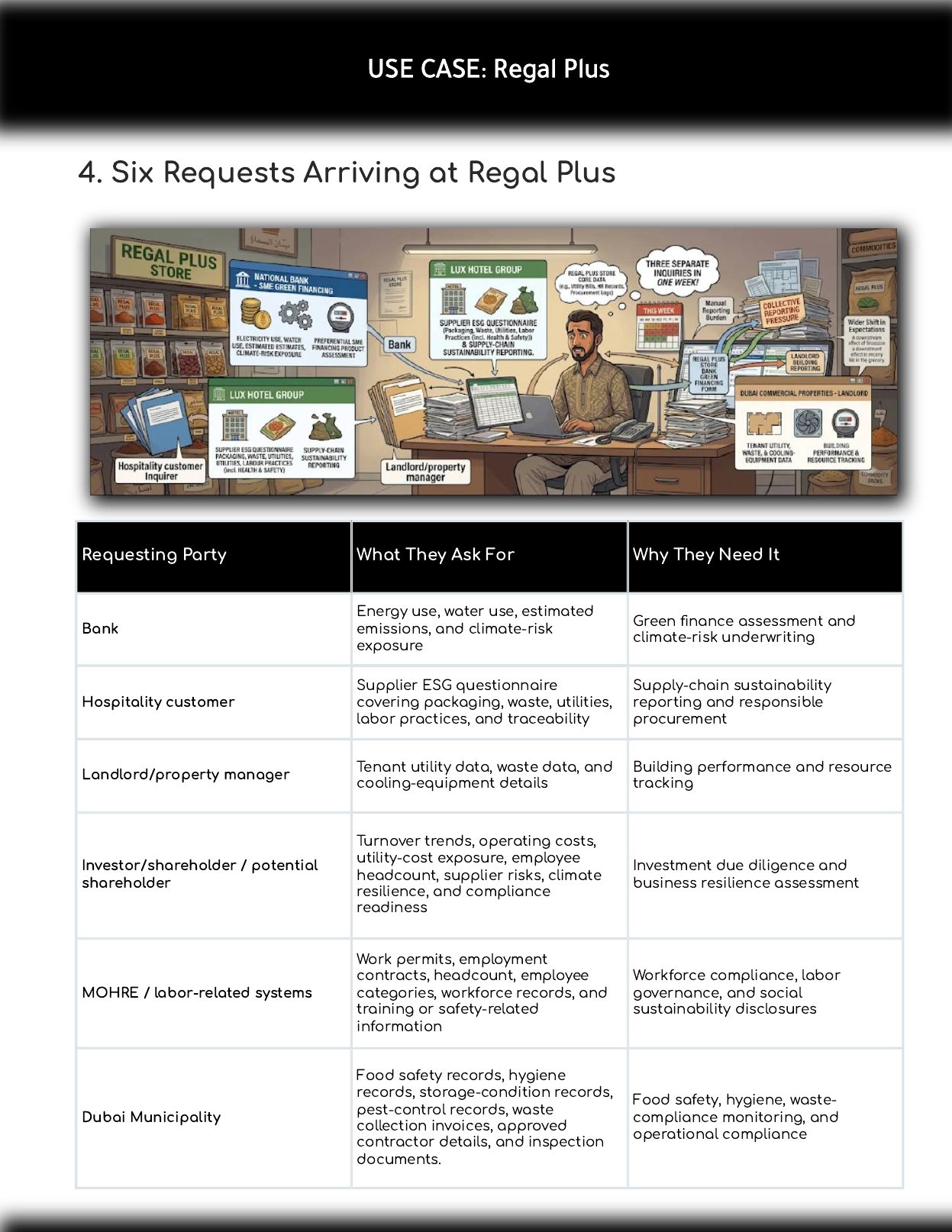
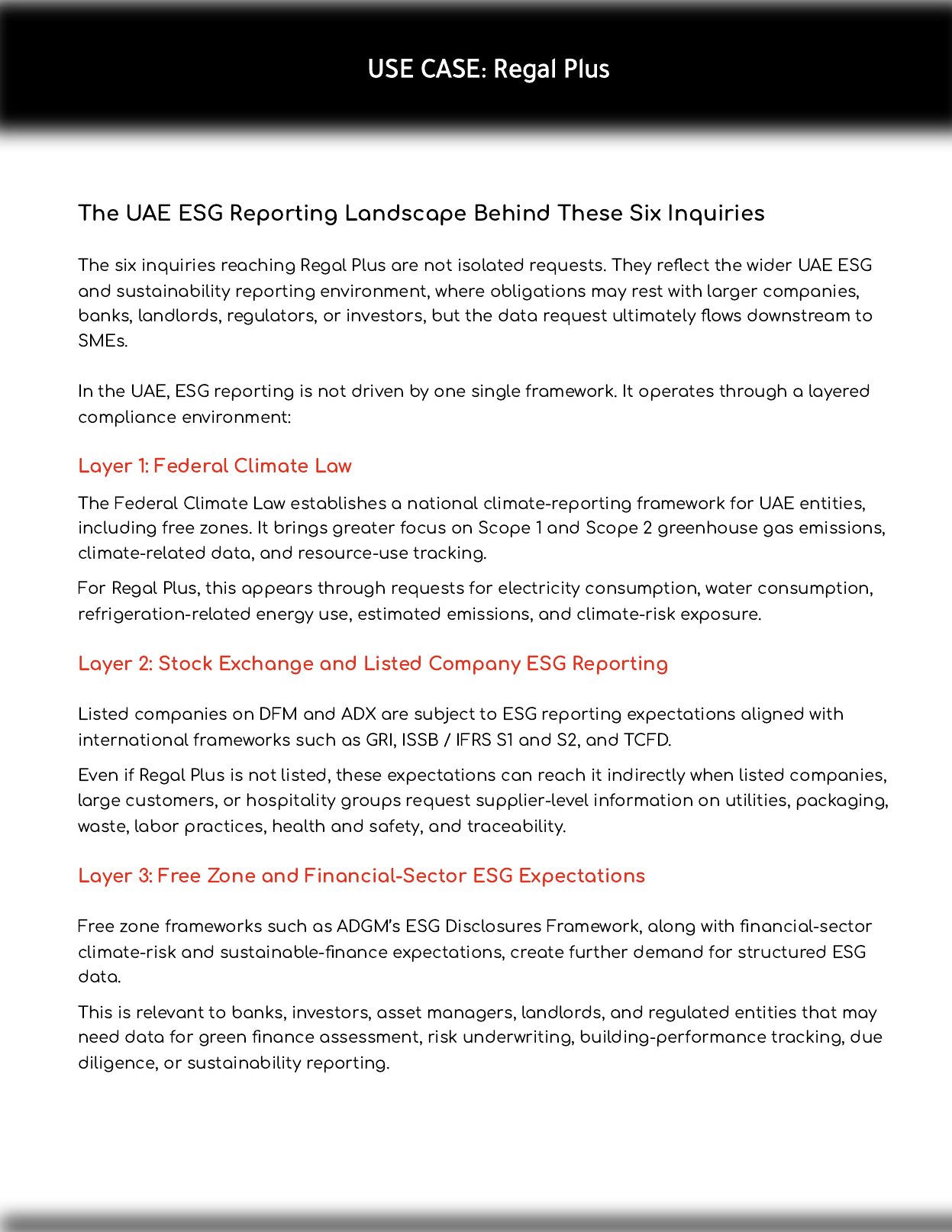
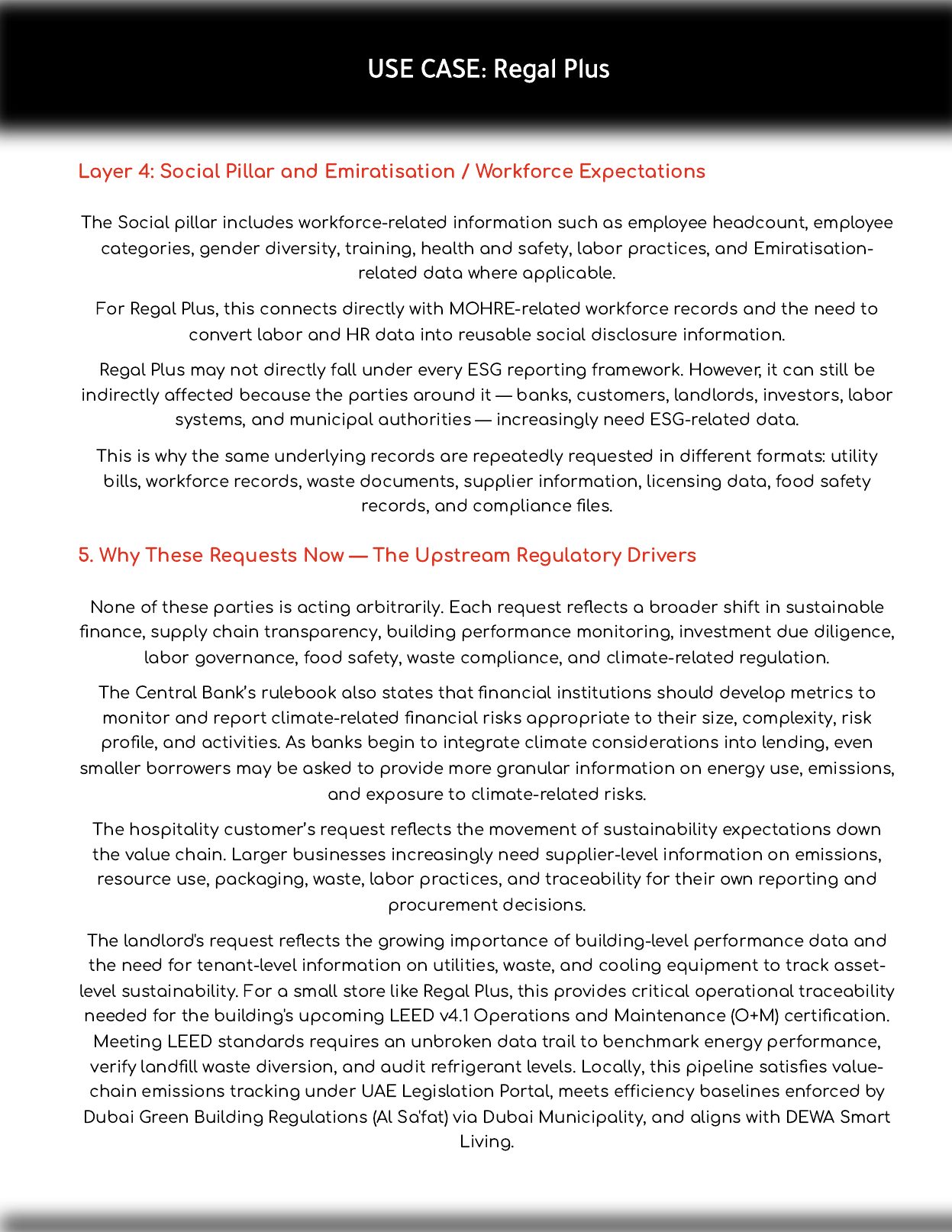
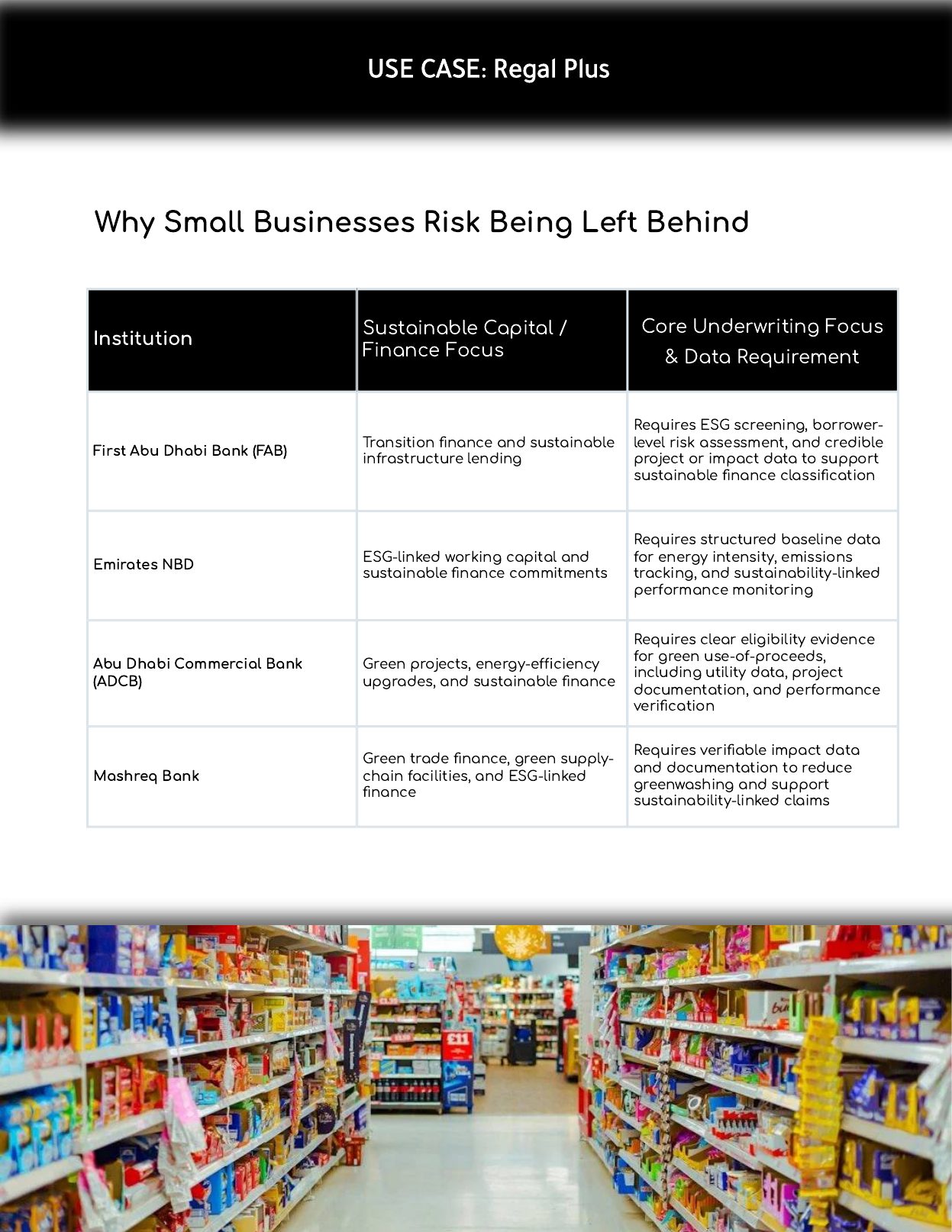
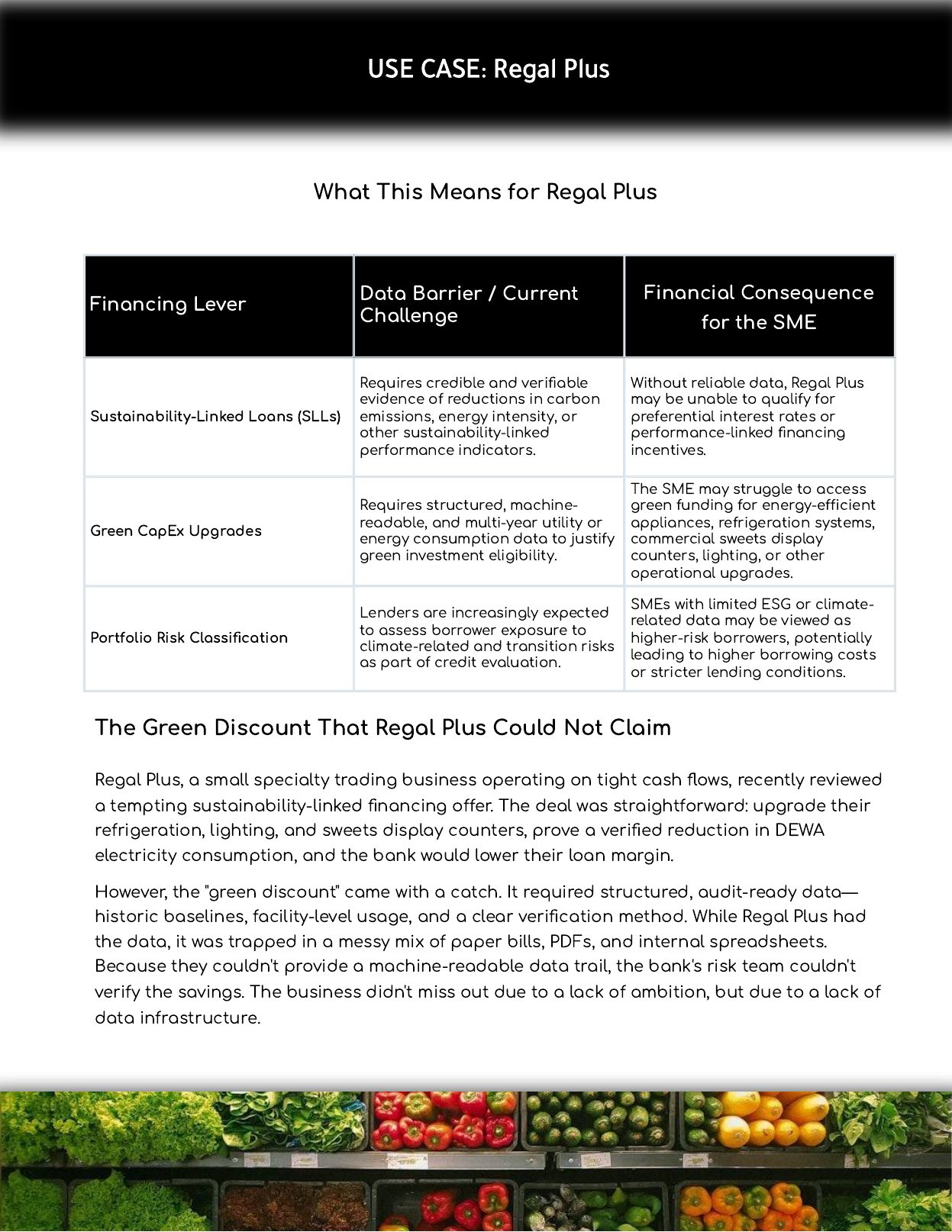
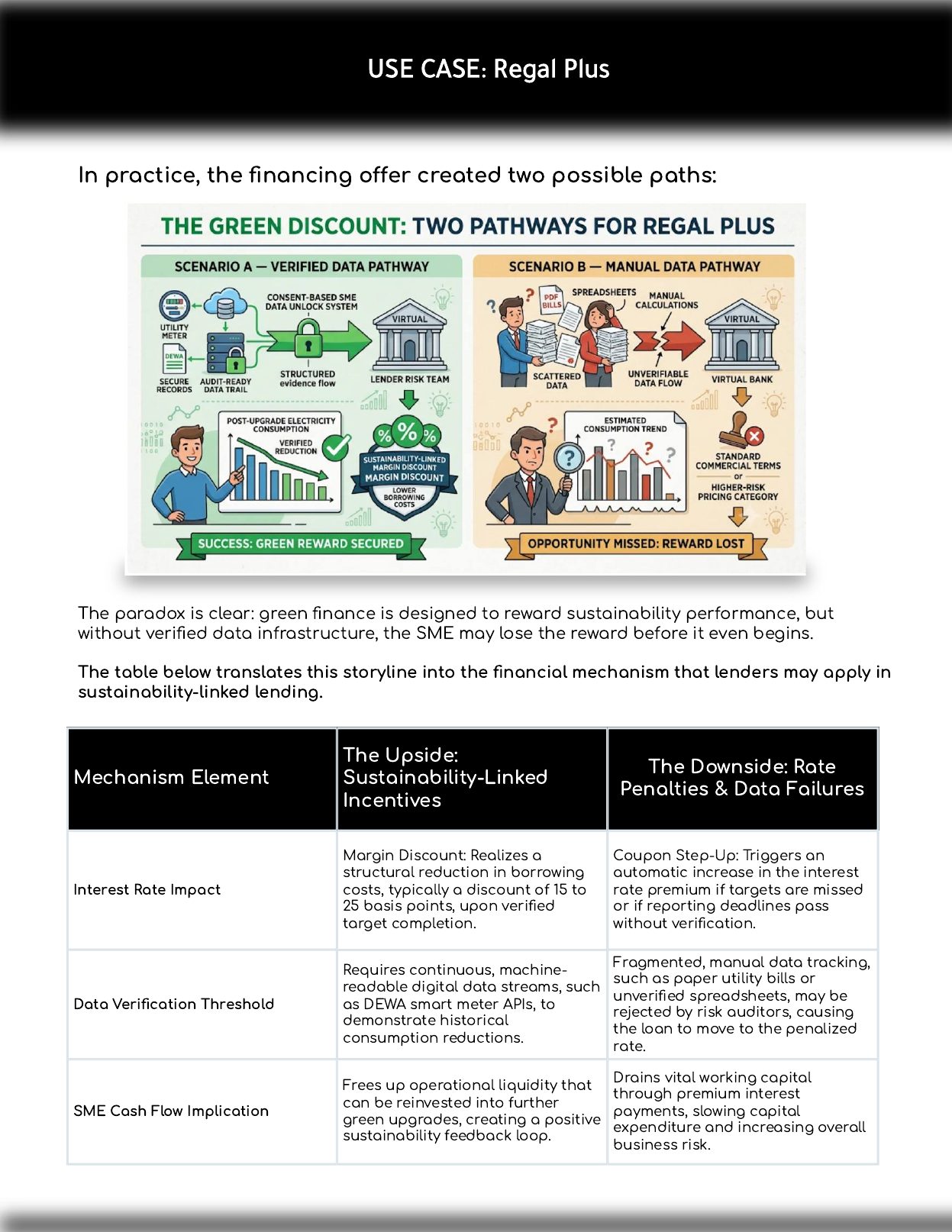
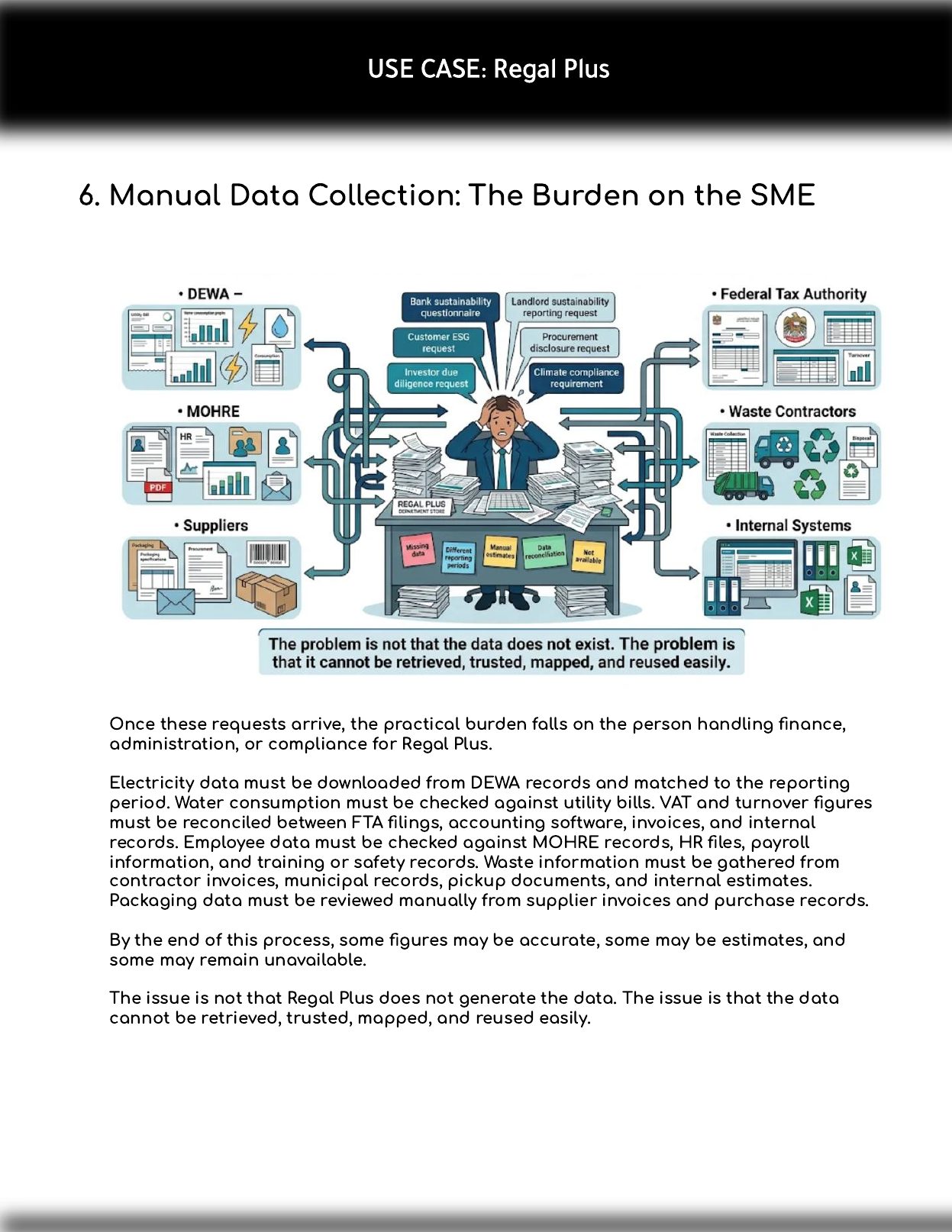
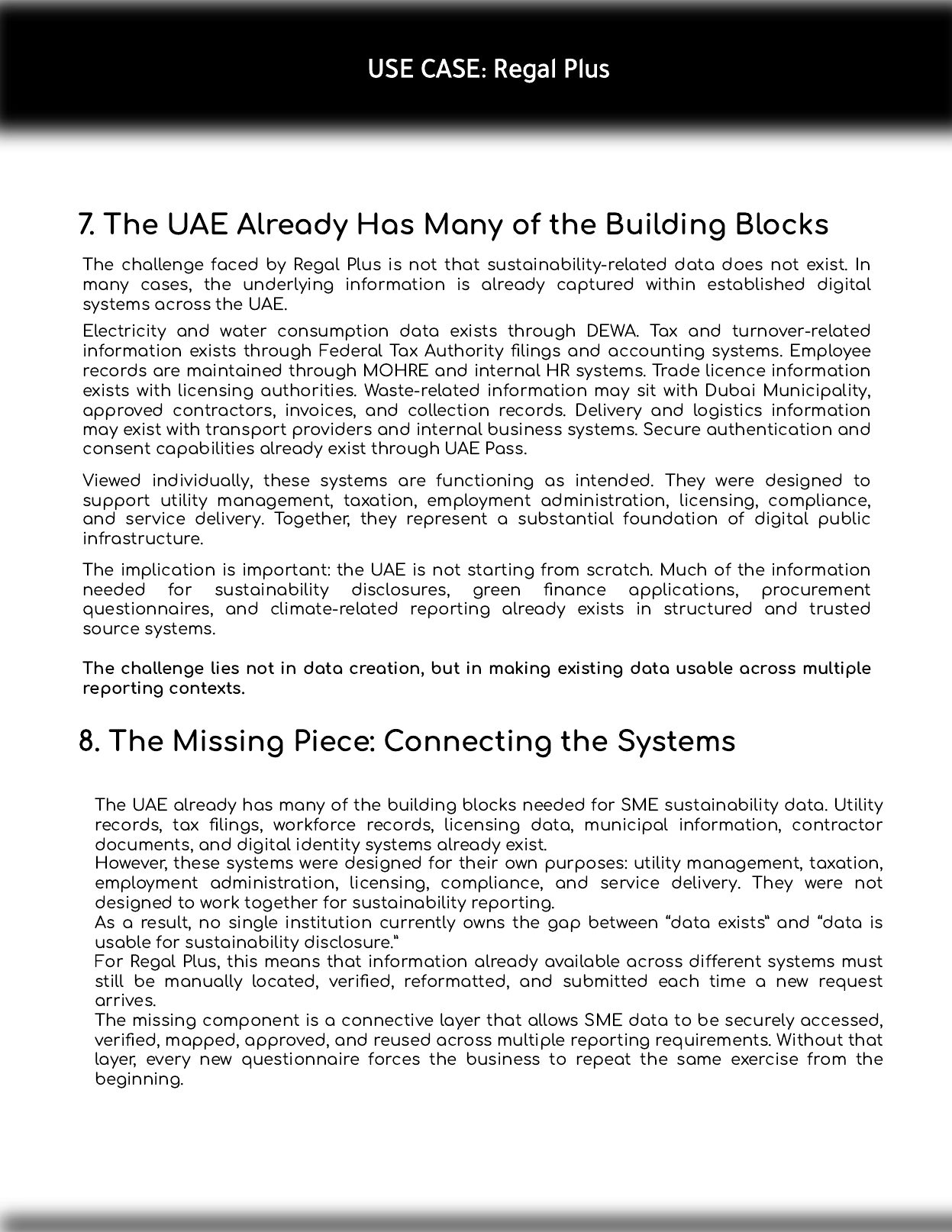
Illustrative Use Case · Regal Plus, Bur Dubai Branch
UAE
“The sustainability data SMEs need already exists — they just need access to it.”
Download Full PDF ↓

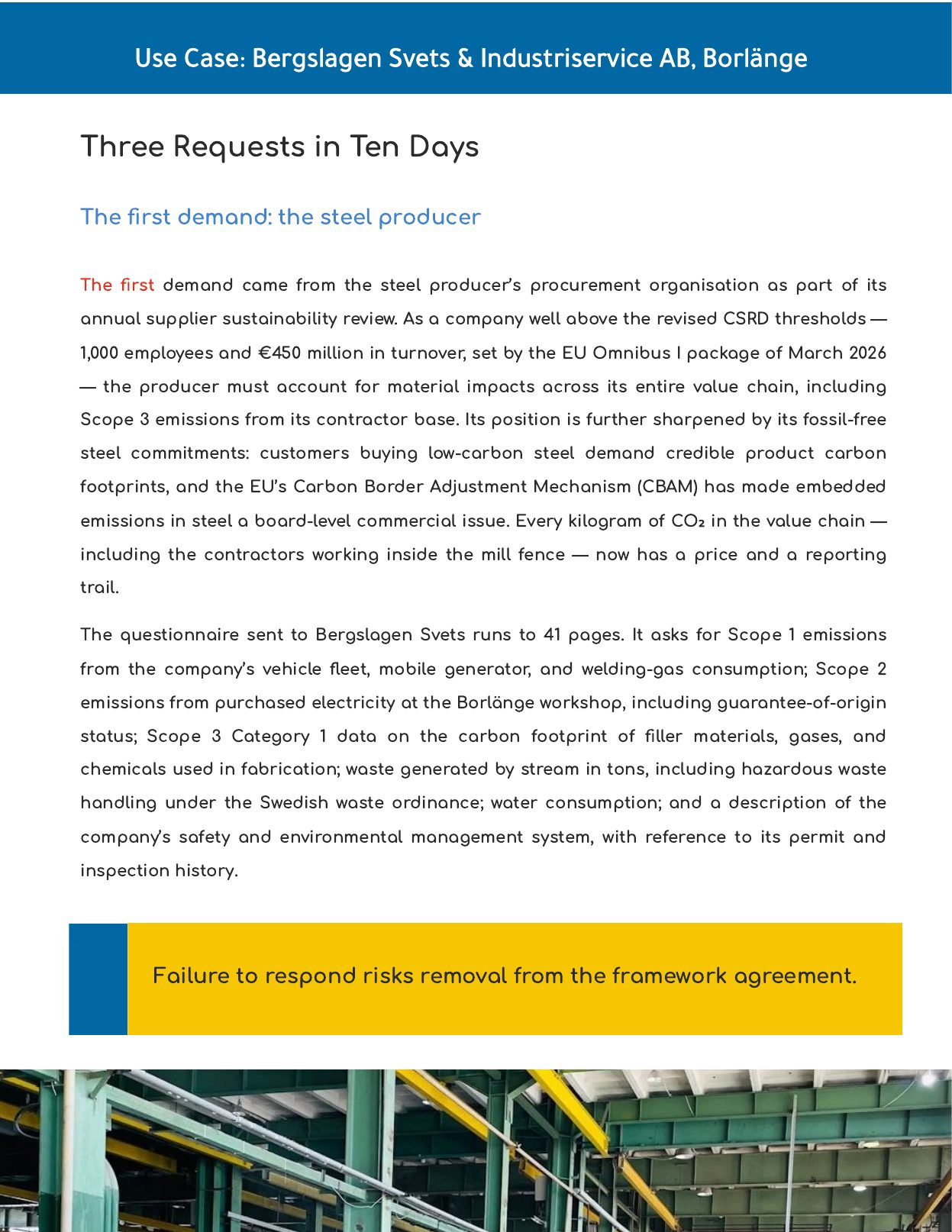
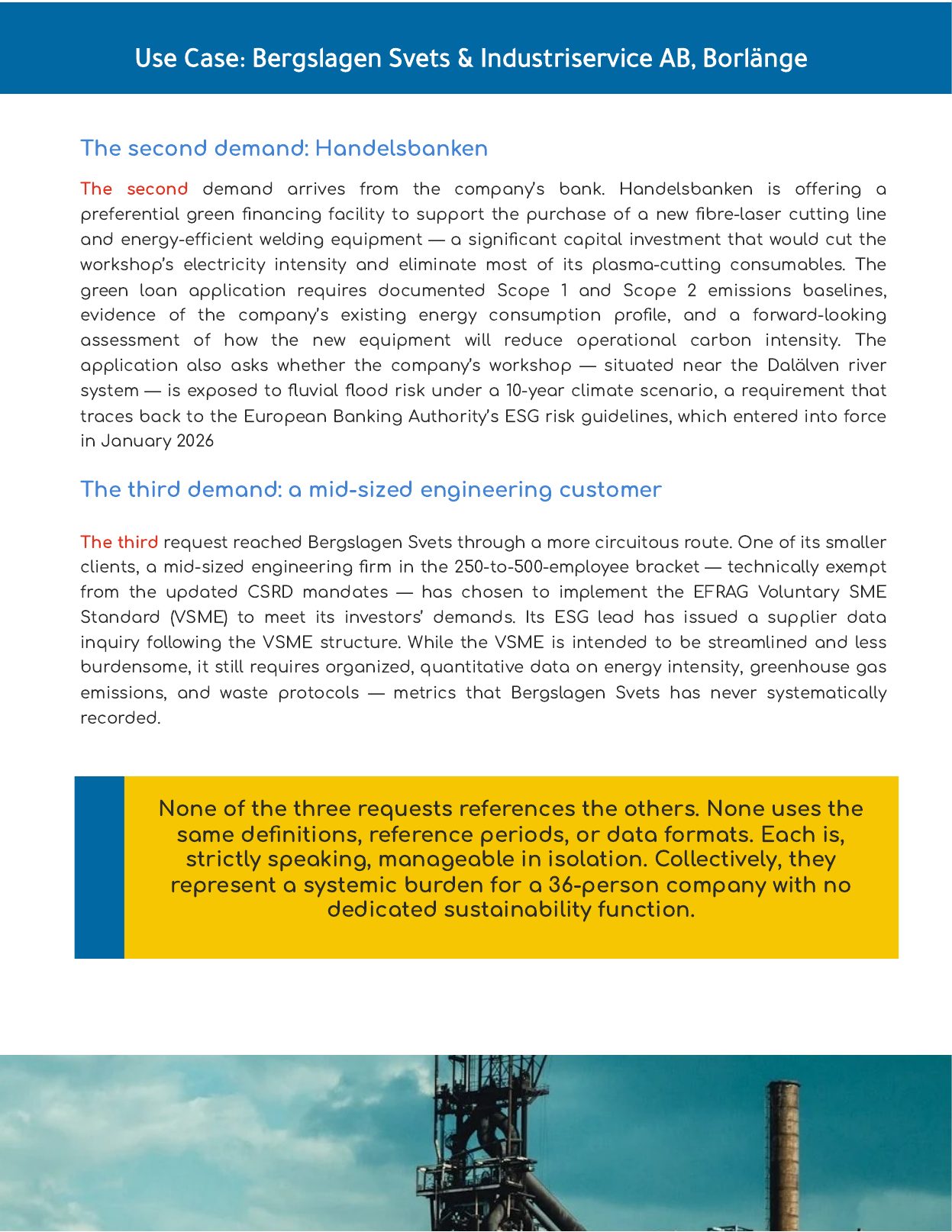
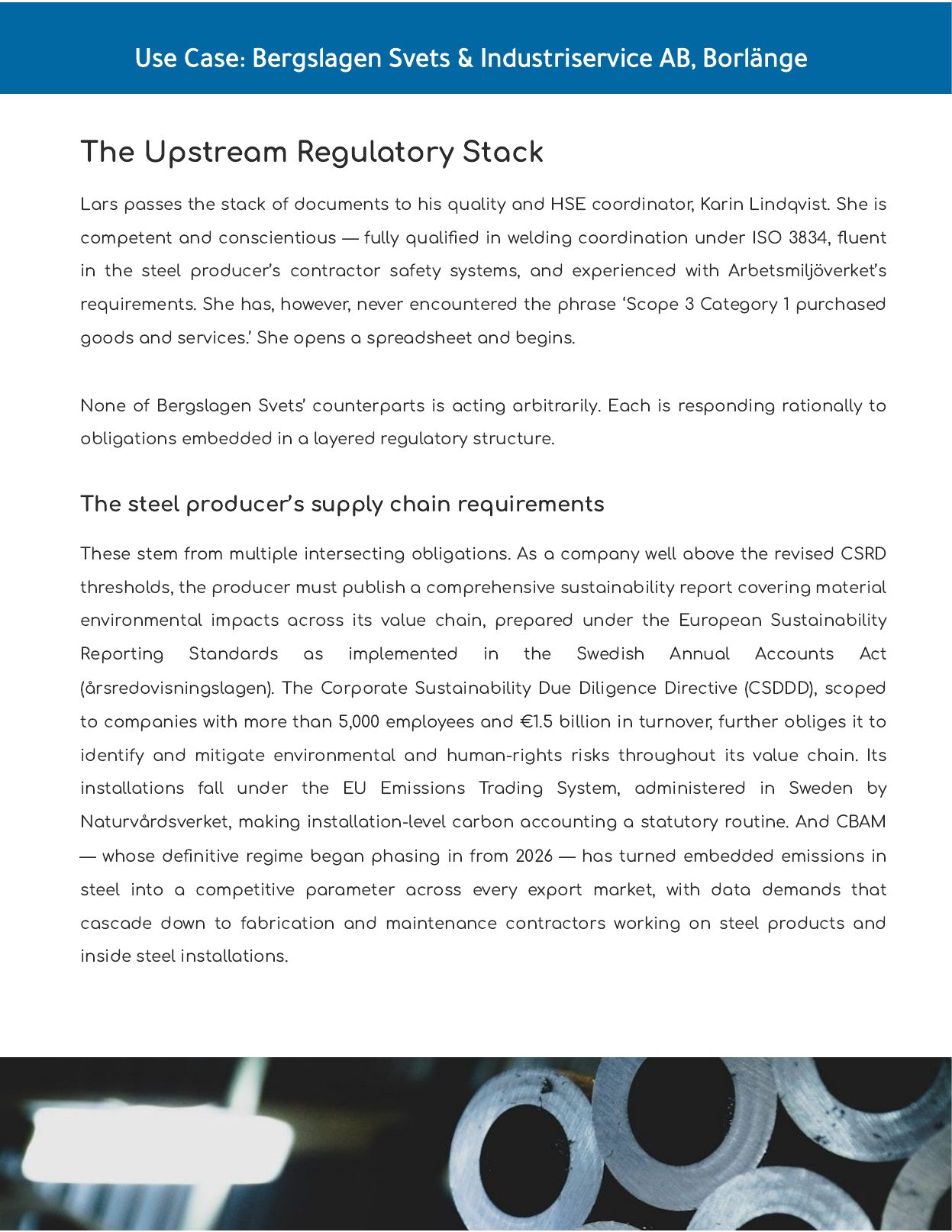
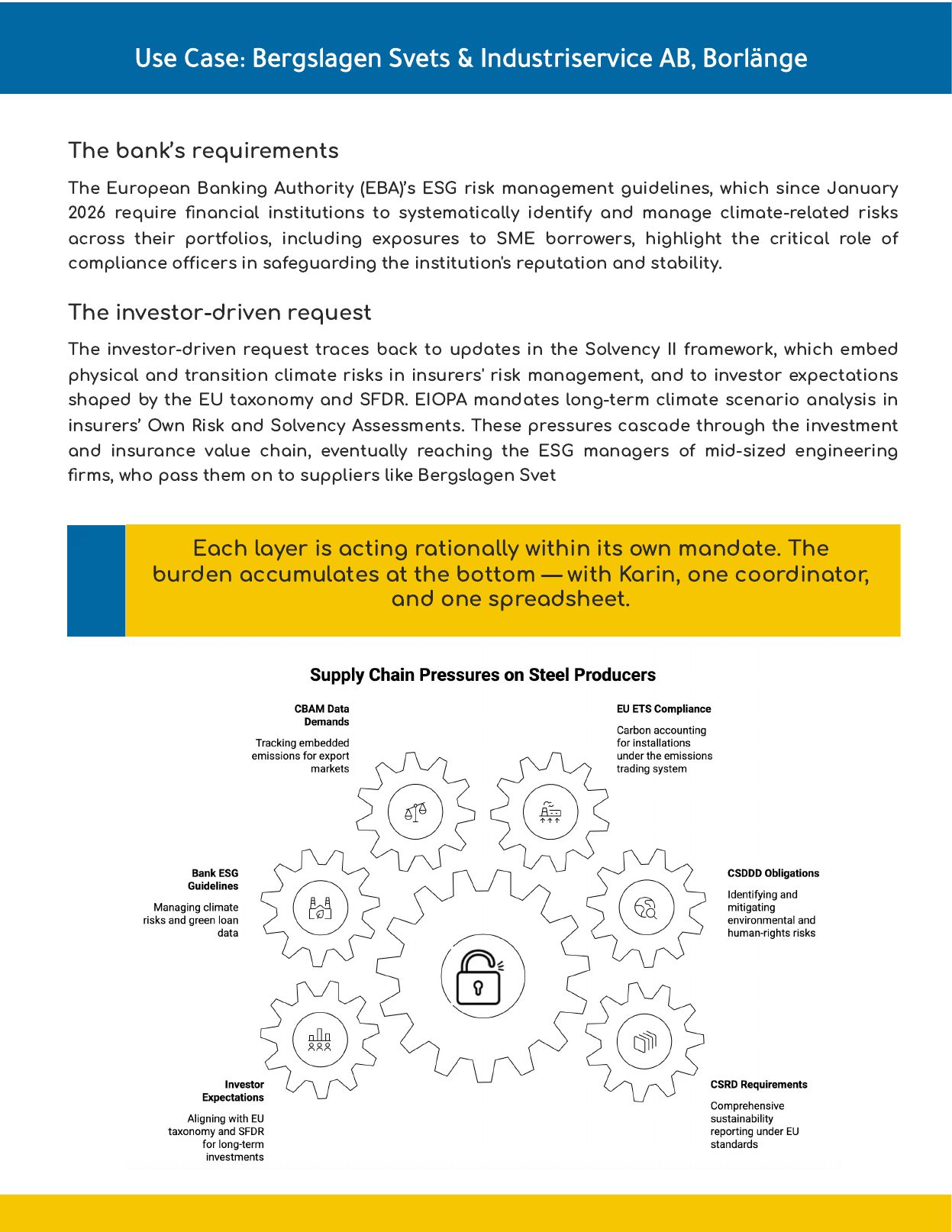
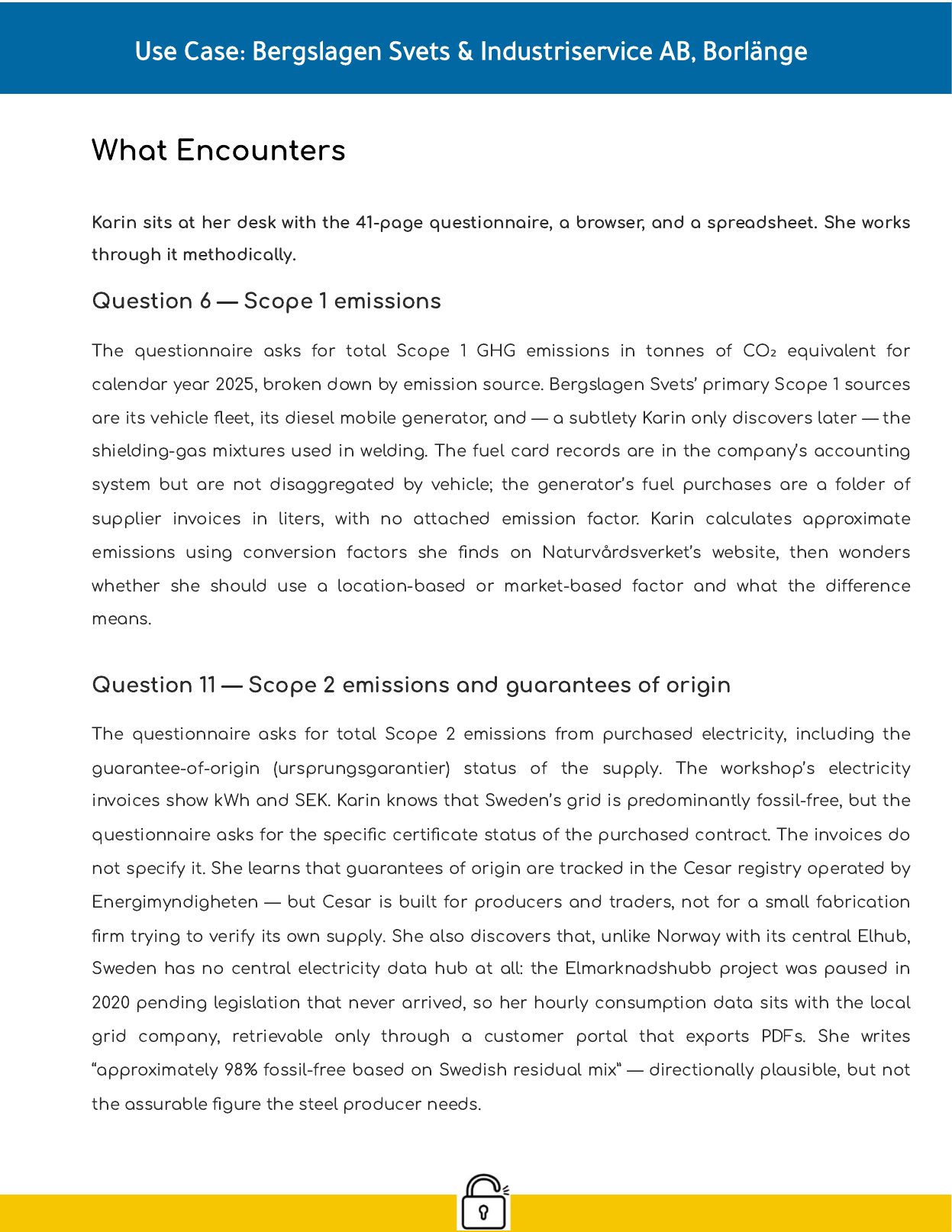
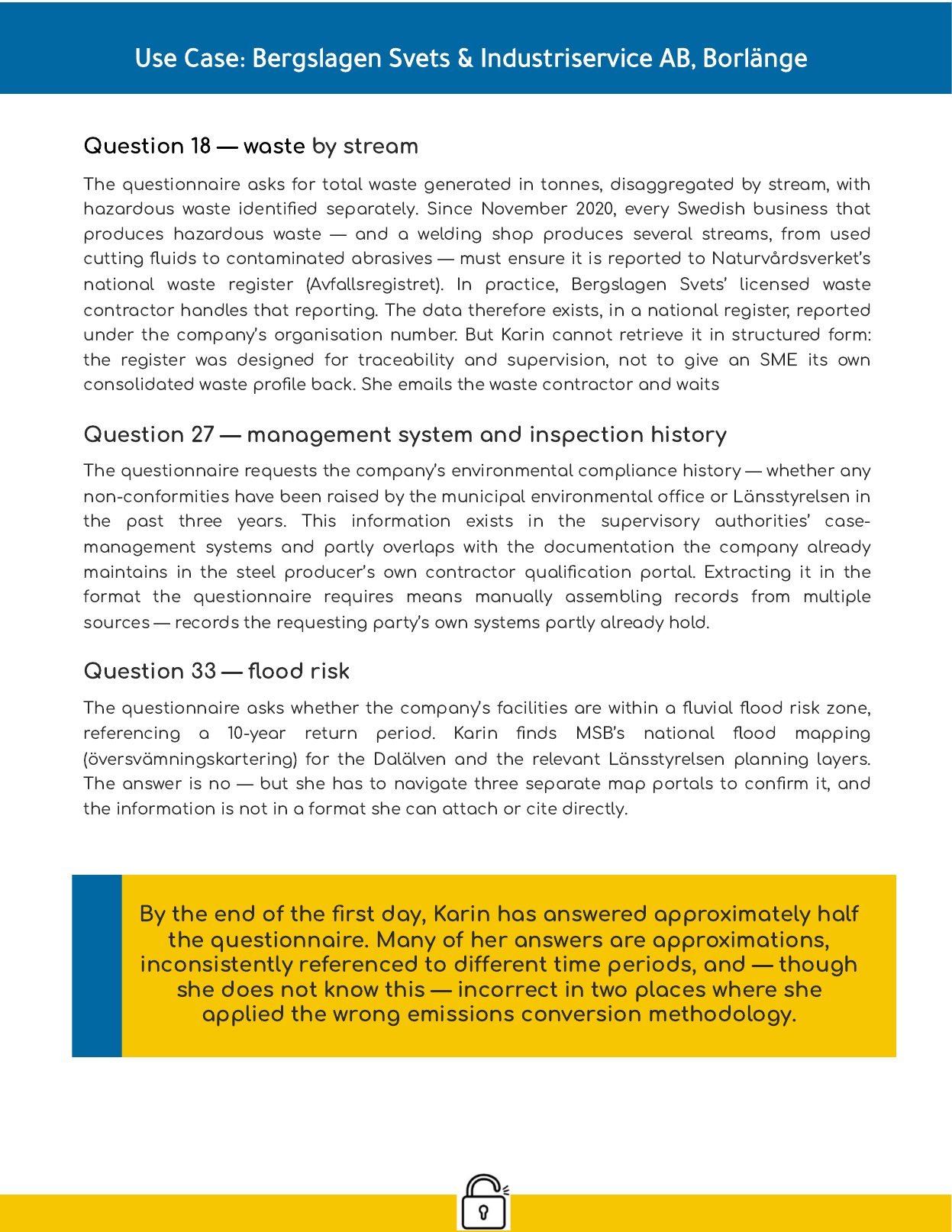
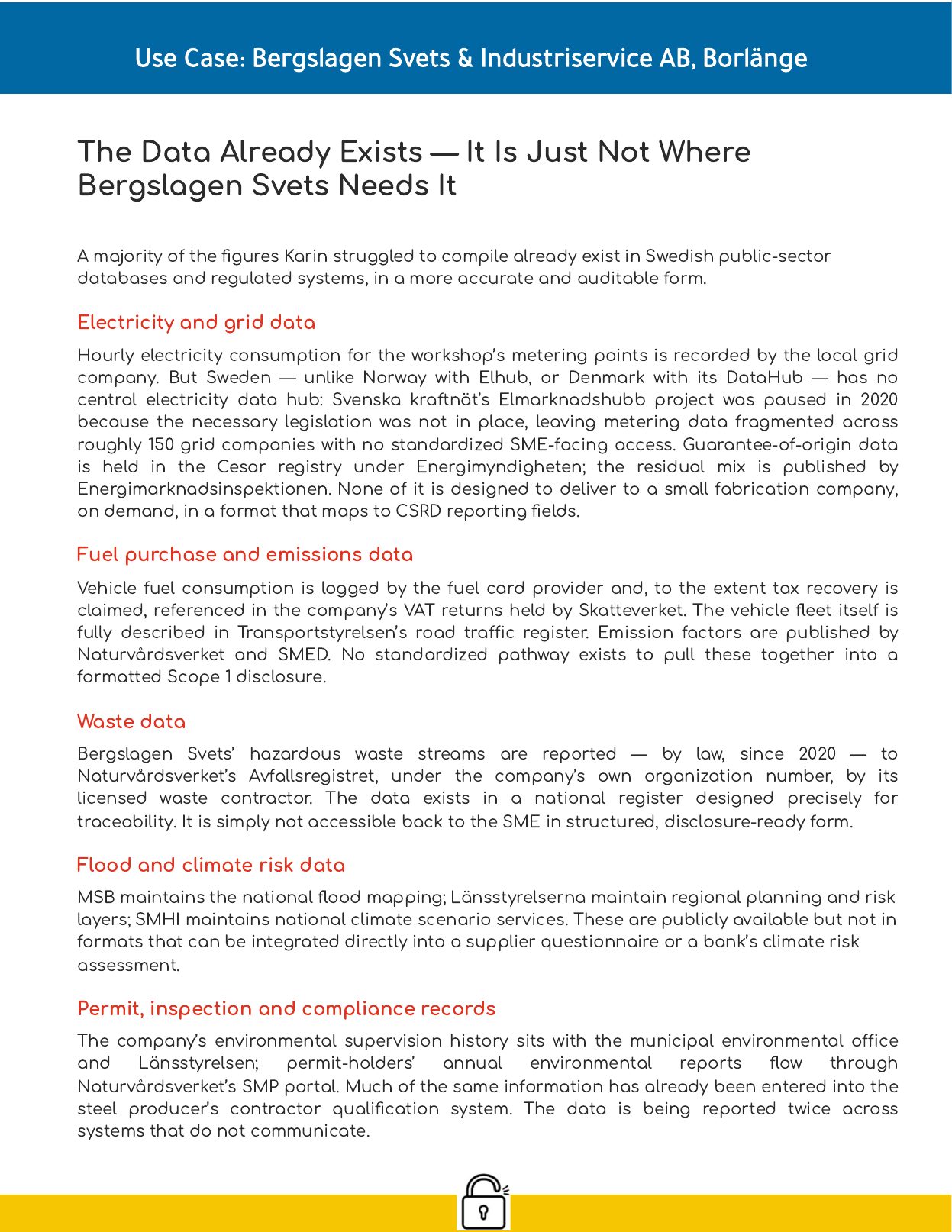
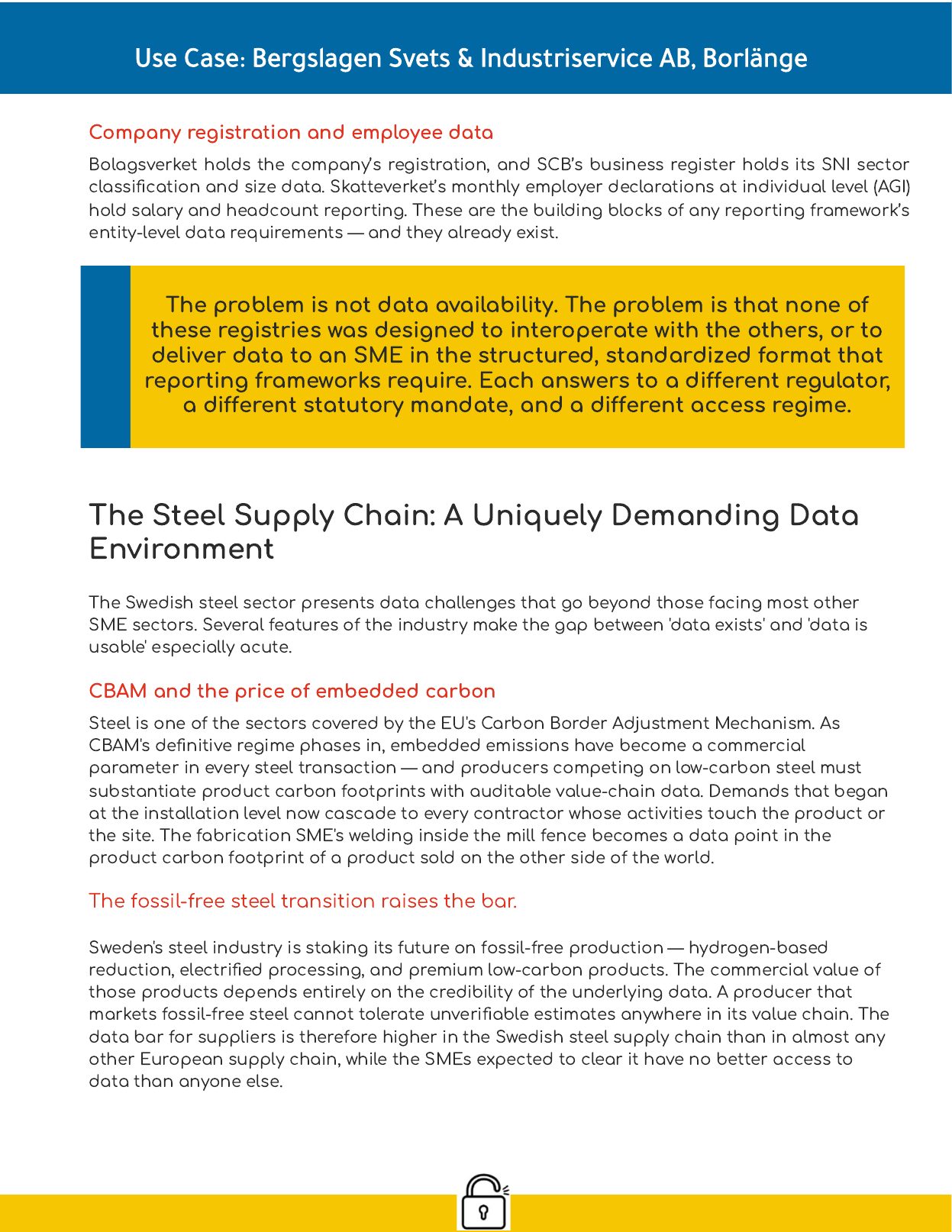
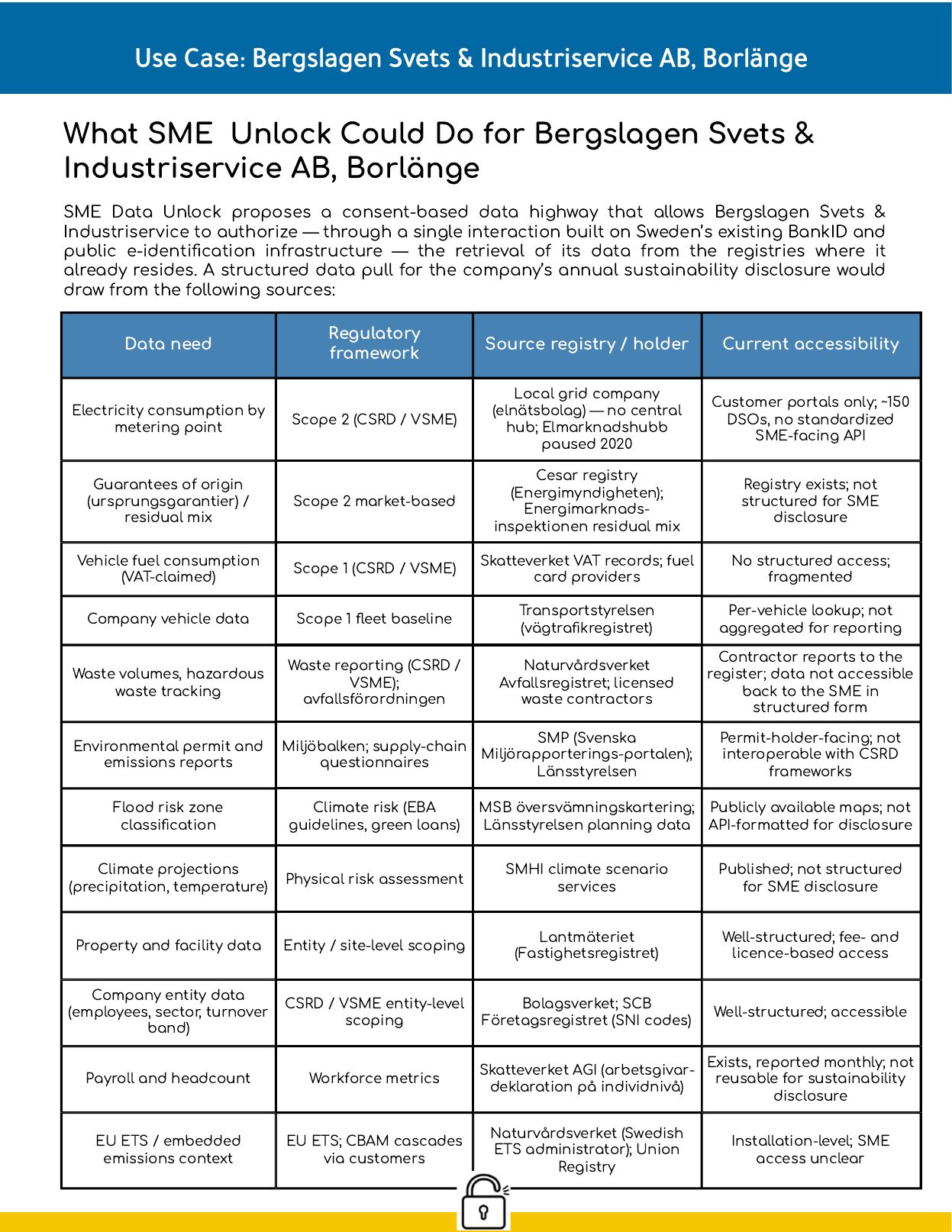
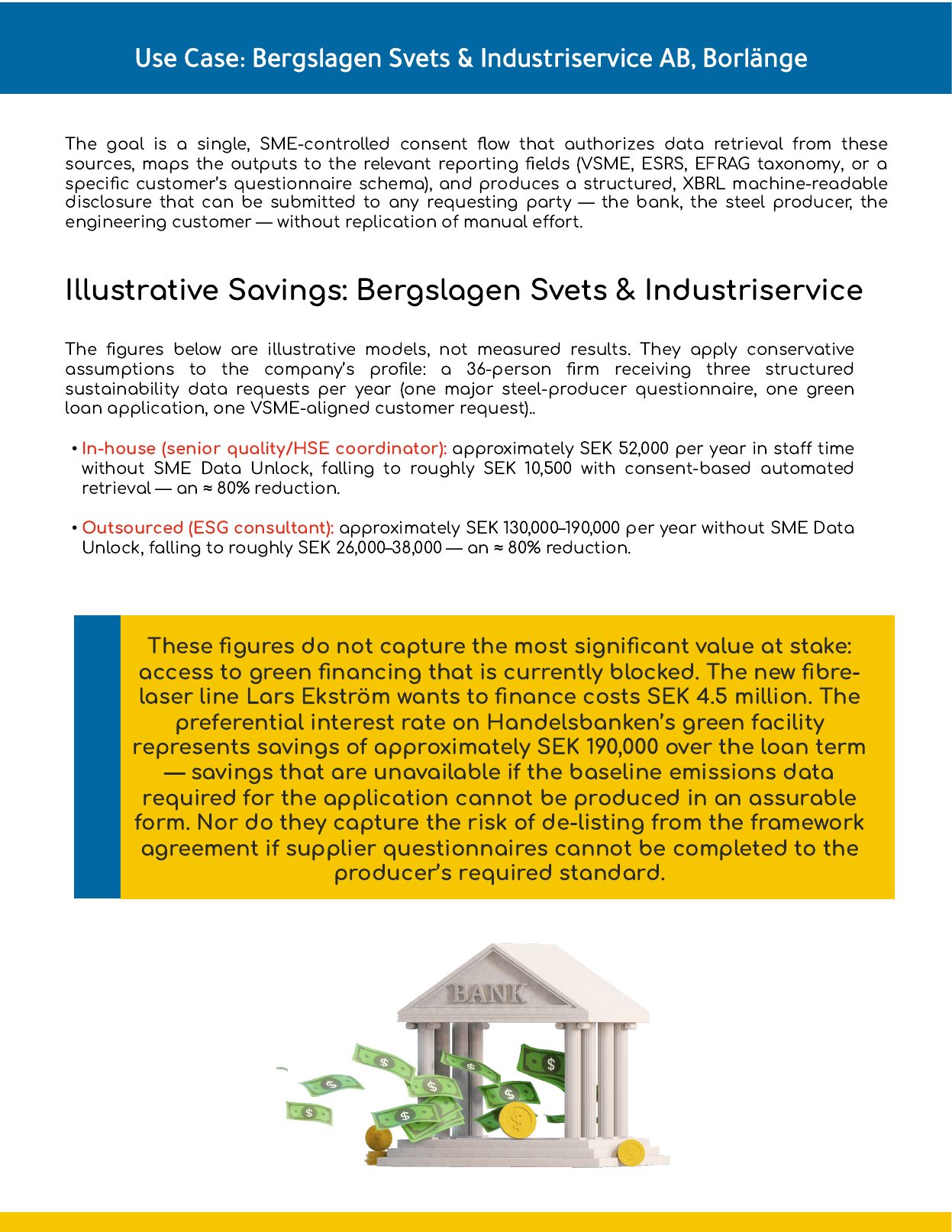
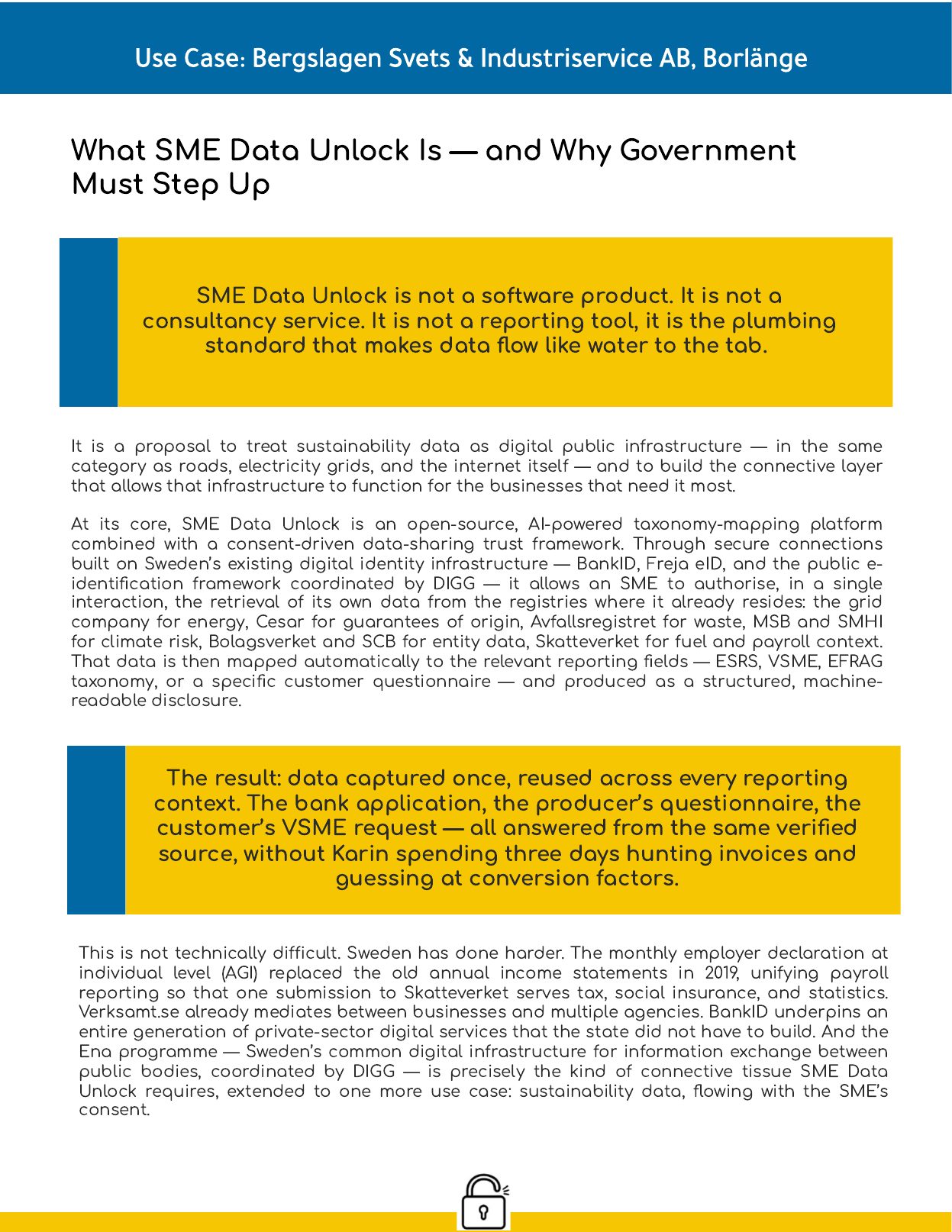
Illustrative Use Case · Bergslagen Svets & Industriservice AB, Borlänge
Sweden
“The sustainability data SMEs need already exists — they just need access to it.”
Download Full PDF ↓
Data Deep Dives
Exploring multiple data accessibility domains.
SME Data Unlock is committed to examining the broader implications of data accessibility through a global lens. Our work explores the essential data architectures, metadata standards, and registry designs required to support SME reporting obligations across diverse jurisdictions—from the EU's Voluntary SME Standard (VSME) to emerging global disclosure regimes.
Through reports, blogs, and webinars, this thought leadership work also explores how the same data infrastructure challenges surface in adjacent domains — from nature and climate to AI sustainability and health — where the data exists, but the systems to make it usable, linkable, and trustworthy do not. These explorations inform and strengthen the core SME Data Unlock agenda rather than standing as separate initiatives.
Exploration — Nature Data
Explores how trusted, standards-aligned nature and biodiversity data can support conservation finance, environmental markets, and policy interventions. Reliable, interoperable environmental data faces many of the same structural gaps as SME data, making decision-ready information hard to access and act on.
Exploration — AI Sustainability
Examines the fragmented U.S. and EU regulatory landscape for AI-driven data center growth and the lack of a coordinated, digital-first framework for environmental disclosure. Considers a shared reporting architecture and facility-level taxonomy so that energy, water, emissions, and biodiversity data can be captured once and reused across regulatory and financial reporting regimes. This exploration extends to how agent metadata standards could similarly capture the environmental footprint of AI agents — energy use, GHG emissions, data minimization, and infrastructure efficiency — as a comparable attribute of agent registries rather than an afterthought.
Exploration — Health Data
Considers how federated, consent-based data infrastructure could strengthen public health systems and improve clinical and population-level insights. Highlights parallels with the interoperability and trust challenges SMEs face, and how responsible innovation in health technology depends on solving similar data foundation problems.
Exploration — EU Digital Product Passport

Hosted by: Bellona Foundation Co-Founders: Catherine Atkin, Liv Watson
Flagship SME Initiative
A flagship initiative co-founded by Liv Watson and Catherine Atkin and hosted by the Bellona Foundation in Norway, demonstrating how governments can unlock sustainability and operational data already held in public registries and regulated systems. Through secure, consent-based, open-source data exchange platforms, SMEs gain access to the trusted data they need for reporting, financing, and competitiveness.
SME Data Standards and Policy
A strategic dialogue examining the data architecture, metadata standards, and registry design required to support SME reporting obligations across jurisdictions, including the EU’s Voluntary SME Standard (VSME), the EU Digital Product Passport Registry, and other global disclosure regimes. This work explores how interoperable, machine-readable data structures can reduce duplicative reporting burdens for SMEs subject to multiple, overlapping frameworks. It further considers how trusted, product- and entity-level data can accelerate compliance, competitiveness, and market access across European and global value chains.
EU Digital Product Passport Registry
Lead: Liv Watson Contributors: X, Y, and Z
A strategic conversation examining the data architecture, metadata standards, and registry design required for the EU’s emerging Digital Product Passport ecosystem. This work explores how interoperable, trusted product-level data can accelerate circularity, compliance, and market transparency across European value chains.
2 – Nature Data Unlock
[Logo / visual placeholder — to be added]
Contributors: Cathrine Armour, Katherine Foster, Liv Watson, Catherine Atkin
The global transition toward nature-related disclosure and decision-making is creating an urgent need for a common framework that makes biodiversity and nature data discoverable, understandable, and interoperable across jurisdictions, sectors, and platforms. While significant progress has been made in developing reporting frameworks, datasets, and digital infrastructures, the underlying metadata and taxonomy governance needed to connect these resources remains fragmented.
This dialog seeks to establish an interim governance framework for nature-data metadata standards and taxonomy stewardship, creating a practical bridge between today’s fragmented ecosystem and the longer-term vision of a Nature Data Trust and Nature Data Public Facility (NDPF). The initiative will focus on developing a trusted, globally aligned approach to metadata governance that enables consistent identification, classification, exchange, and reuse of nature-related data across public and private sectors.
The concept brief below recognizes that successful governance requires both technical standards leadership and broad public-interest oversight. XBRL International and the Data Foundation would provide technical stewardship, leveraging their experience in digital reporting standards, taxonomy governance, and interoperability. Complementing this role, the TNFD, the Bellona Foundation’s SME Data Unlock Initiative, and the Data Foundation, would provide stakeholder engagement, convening, fundraising support, and public-interest governance to ensure broad legitimacy and adoption.
By bringing together expertise from the digital reporting, biodiversity, data governance, and public infrastructure communities, the project aims to accelerate the development of an open, trusted, and scalable nature-data ecosystem. The outcome will be a governance framework capable of supporting interoperability between biodiversity datasets, corporate disclosures, regulatory reporting systems, and emerging nature-data platforms, while establishing a clear pathway for eventual transition to permanent stewardship under the Nature Data Trust and NDPF.
Ultimately, the project will help lay the foundation for a globally connected nature-data infrastructure that improves transparency, enables better decision-making, reduces reporting fragmentation, and supports the effective mobilization of capital and action toward nature-positive outcomes.
Below is a concept note for discussion and seeking feedback.
Concept Note: Common Metadata Requirements for Nature Data
Why It Matters and the Role of SME Data Unlock — a concept brief on TNFD Recommendation 2, prepared to stimulate discussions.
1. Why This Matters Now
Metadata is not a technical afterthought. It is the enabling infrastructure that allows nature data to be discovered, assessed, compared, licensed and reused at scale. Without common metadata standards, the other recommendations cannot achieve their intended impact. The Nature Data Public Facility (NDPF) cannot reliably signal data quality; the data principles outlined in Recommendation 1 cannot be consistently verified; and harmonized licensing under Recommendation 3 lacks a common foundation on which to operate.
For business leaders, investors and policymakers, the significance is straightforward: metadata is what turns fragmented datasets into decision-useful information. It creates the transparency, traceability and interoperability required for markets to trust nature-related disclosures and analytics. For SMEs in particular, it can dramatically reduce compliance costs and reporting burdens by enabling information to be captured once and reused many times.
This challenge is not new. It is similar to the transformation that occurred in financial reporting through XBRL. Before standardized, machine-readable reporting, financial data was largely human-readable, difficult to aggregate, costly to compare, and challenging to audit at scale. XBRL addressed this structural problem by creating a common digital language for financial information. Nature data now faces a similar inflection point.
The risk is that without a shared, open approach to metadata infrastructure, the costs and complexity of nature-related reporting will fall disproportionately on small and medium-sized enterprises. If natural data is to flow through the economy as efficiently as financial data, we must focus not only on reporting requirements but also on open standards, shared digital infrastructure, and reusable components that make compliance practical and affordable.
2. The Evidence: A Value Chain Running on Undocumented Data
TNFD’s pilot testing (March–September 2025, 120 datasets, 40+ data providers) found that metadata practice across the nature data value chain is inconsistent to the point of undermining trust in the underlying data itself:
| Finding | Implication |
|---|---|
| 61% of data providers use no formal metadata standard | No governance, accountability or defined quality process behind most datasets |
| Metadata submissions frequently incomplete or inconsistently structured | Gaps in documentation, categorization and methodological transparency |
| Many datasets lack verified provenance or geographic specificity | Comparability and integration across datasets is compromised |
| Only a small minority apply recognized standards (e.g. ISO 19115) | Most rely on partial or locally defined approaches, blocking interoperability |
The downstream consequence is direct and measurable: 88% of downstream pilot participants agreed that standardized metadata in the NDPF would make it easier to search, filter, compare and assess the relevance of data — meaning the current absence of a common schema is actively costing users time, money and confidence today, not hypothetically in the future.
3. Who Should Host This?
TNFD rightly leaves the long-term governance question open, suggesting that metadata governance could ultimately sit with the Technical Advisory Board of a future Nature Data Trust. However, the Trust and the proposed NDPF are likely to require significant time to secure funding, establish governance structures, and reach operational maturity. The market cannot afford to wait.
To maintain momentum, an interim governance model is needed now. The mandate encompasses two distinct functions — technical standards stewardship and public-interest governance — best served by different organizations working in partnership.
3.1 Technical Standards Stewardship and Taxonomy Governance
The technical stewardship role is a natural fit for XBRL International and the Data Foundation. Together, these organizations bring a unique combination of standards-setting expertise, market connectivity, and implementation experience that positions them to convene and lead a credible global dialogue on taxonomy governance and interoperability in digital reporting.
XBRL International has a proven track record of creating, maintaining, and governing machine-readable reporting standards across complex and fragmented ecosystems, serving as the digital bridge between major sustainability reporting frameworks and taxonomies, including the ISSB, the ESRS, and the GRI.
The Data Foundation complements this technical expertise with deep engagement across the reporting, regulatory, technology, and policy communities, acting as a trusted, neutral convenor.
3.2 Convening, Funding and Public-Interest Oversight
Technical standards alone will not deliver adoption. The effort also requires an independent, multi-stakeholder convener capable of balancing the interests of data providers, investors, public institutions, Indigenous Peoples and Local Communities (IPLCs), and end users.
A coalition comprising the Bellona Foundation and its SME Data Unlock Initiative, the Daat Foundation and the Adria Future Foundation is well positioned to provide this stewardship function, bringing established relationships across the biodiversity, environmental data and digital public infrastructure communities, including engagement with GBIF, UNEP-WCMC, national biodiversity institutes and public-sector digital transformation initiatives.
Recommended Interim Structure
Establish a joint stewardship model until the Nature Data Trust and Nature Data Public Facility become operational.
- XBRL International and the Data Foundation would jointly lead stewardship of technical standards, including taxonomy governance, metadata architecture, interoperability frameworks, implementation guidance, and alignment with existing digital reporting standards and regulatory requirements.
- The Bellona Foundation, through its SME Data Unlock Initiative, together with the Daat Foundation and Adria Future Foundation, would provide convening, stakeholder engagement, fundraising support, and public-interest governance, ensuring the framework reflects the needs of diverse stakeholders, including data providers, investors, public institutions, IPLCs, and civil society.
- The partners would operate under a formal governance framework or Memorandum of Understanding that clearly defines responsibilities, decision-making processes, and accountability mechanisms, and establishes a structured pathway for the eventual transition of stewardship responsibilities to the Nature Data Trust and the NDPF once those institutions are fully established.
4. The Questions That Need Answering
- Governance: who has final decision rights over schema changes, and on what cycle — TNFD suggests a three-to-five year review, but who chairs it in the interim before the Nature Data Trust exists?
- Identifier architecture: who operates the persistent Nature Data Identifier (ND.ID) registry, and on what legal and funding basis — a single centralized registrar, or a federated model similar to DOI/ORCID?
- Standard selection: how are the four foundational standards (ISO 19115, Darwin Core, EML, MIxS) reconciled with the ISSB XBRL taxonomy without creating a fifth, competing schema?
- Funding: is metadata governance financed as a standalone grant-funded public good, or folded into NDPF/Nature Data Trust financing once that facility reaches breakeven (TNFD models Year 3, 2028)?
- SME accessibility: how is the schema kept simple enough that a small forestry or metalworking company can self-tag a dataset without hiring a data scientist — the same design problem SME Data Unlock has already solved for CSRD/VSME reporting?
- Incentives: what motivates a data provider with no formal metadata practice today (61% of the pilot sample) to adopt a new standard — mandate, market access, funding eligibility, or reputational recognition?
- Consent and CARE: how is Free, Prior and Informed Consent operationalized in metadata for datasets touching Indigenous or community land, and phased in without stalling adoption elsewhere?
- Interoperability with existing registries: how does a new ND.ID avoid duplicating GBIF’s existing identifier and citation infrastructure, rather than fragmenting it further?
5. Why This Is Worth Doing
- Trust at the point of use: confidence flags against the seven data principles let a user judge a dataset’s fitness for purpose in seconds rather than weeks of due diligence.
- Machine readability and AI-enabled cataloging: standardized metadata is the precondition for the search, filter, and comparison functions the NDPF is designed to offer — and for any AI-assisted assessment tooling built on top of it.
- Regulatory alignment: an XBRL taxonomy-aligned metadata layer keeps nature disclosures consistent with ISSB and CSRD digital tagging requirements, rather than creating a parallel, incompatible reporting language.
- Lower the cost of assessment for SMEs: consistent metadata makes it possible for a facility to serve small and micro end-users at no cost, cross-subsidized by larger users — the NDPF’s core commercial design depends on this working.
- Unlocking capital: EBRD, development finance institutions, and commercial lenders cannot price nature-related risk into credit decisions using data they cannot verify or compare — standardized metadata is a precondition for the finance-gap arguments already being made in the EBRD/GET 2030 engagement.
- Reduced duplication: a shared schema stops upstream providers, downstream analytics firms and corporates from each re-cleaning and re-documenting the same underlying data.
Prepared to inform internal Alliance discussion and external funder engagement. Not for public circulation without review.
3 – AI Sustainability Data Unlock
Digital Standards for Data Center Sustainability Reporting
Standardizing Data Center Sustainability Reporting
A strategic dialogue examining the fragmented U.S. and EU regulatory landscape for AI-driven data center growth and the absence of a coordinated, digital-first framework for environmental disclosure. This work advances a shared reporting architecture and facility-level taxonomy so that energy, water, emissions, and biodiversity data can be captured once and reused across regulatory and financial reporting regimes.
Contributors: X, Y, and Z
7.22 Draft Discussion Doc – Standardizing Data Center Reporting (Google Docs)
Data Center Environmental Reporting Standard Memo (Google Docs)
AI Agent Sustainability Metadata
A companion conversation exploring how agent metadata standards can be extended to capture the environmental footprint of AI agents themselves. This includes verified metrics on energy usage, GHG emissions, data minimization practices, and infrastructure efficiency, ensuring sustainability becomes a native, comparable attribute of agent registries and catalogs rather than an afterthought.
Contributors: X, Y, and Z
4 – Health Data Unlock
[Logo / visual placeholder — to be added]
Contributors: Liv Watson and Ole Petter Ottersen
Lausitz Medical University – Ole Petter Ottersen (Google Docs)
An emerging conversation exploring how federated, consent-based data infrastructure can strengthen public health systems, improve clinical and population-level insights, and support responsible innovation in health data integration technologies. Recognizing that health outcomes are increasingly shaped by environmental and climate-related factors, the dialogue also examines how health data can be responsibly integrated with climate, environmental, and ecological datasets to enable more holistic evidence generation, strengthen resilience, and support better policy and investment decisions across health, sustainability, and societal well-being. Enjoy the discussion and please reach out or sign up for our GitHub Discussions.
Concept Note 1: Health Data Unlock
This concept note proposes that a new university, such as Lausitz Medical University – Carl Thiem (MUL–CT), in Germany, establish and host the Lausitz Dialogue on Health Data & Trust, an annual global convening focused on advancing health data standards, interoperability, and trust frameworks.
Concept Note: A Global Dialogue on Health Data & Trust — and the Research Center Needed to Host It
The field needs an annual global convening and a permanent institutional home for health-data standards, interoperability, and trust. This note sets out what that home must look like — and makes the case that if a digital-by-design university medical center does not step forward to build it, the gap will simply persist.
Prepared for: internal discussion and stakeholder development Draft date: July 2026 — for internal discussion and stakeholder development
1. Executive Summary
Health data sharing for research and prevention sits at the top of the global policy agenda, yet the field lacks a recurring venue where regulators, researchers, hospital leaders, funders, patient representatives, and technology providers meet as equals to address its hardest questions. This note proposes the creation of a premier annual global convening — a Dialogue on Health Data & Trust — to close that gap, and argues that it must be hosted by an institution built for the purpose: a university medical center that is “digital by design” rather than retrofitted, with the governance mandate, funding runway, and active model region needed to convene the field credibly.
Alongside the Dialogue, we propose a companion closed-door retreat — a small standing circle of senior leaders — that develops a longer-horizon framework connecting health, digital infrastructure, One Health, and intergenerational justice into a single post-2030 agenda. The two tracks are designed to proceed together: the Dialogue as the public, practitioner-facing convening on data and trust, and the retreat as the closed, long-horizon body that develops the framework.
The strongest candidate we have identified to host this is Lausitz Medical University – Carl Thiem (MUL–CT), Germany’s newest and only “digital by design” university medical center. Its advantage is structural, not aspirational: free of legacy institutional constraints, it is digital by design from inception. But the argument in this note is deliberately built around the criteria a host institution must meet, not around Lausitz specifically — because the need for this convening does not depend on which institution ultimately answers it. If Lausitz does not build it, the question becomes: who else meets the bar, and if no one does, who is willing to build toward it? The gap does not close itself.
2. The Gap: A Field Without a Home
Health data sharing for research sits at the top of the political agenda — the European Health Data Space (EHDS), the EU Digital Europe Programme, Germany’s DigiG and GDNG, and comparable data-space initiatives in the UK, US, Gulf states, and Asia — yet none of these has produced a recurring venue that resolves the field’s hardest cross-cutting questions: consent architecture, interoperability standards, anonymization thresholds, cross-border trust, and the governance of AI trained on health data.
Existing convenings fall into two categories: broad policy conferences (EHDS stakeholder events, HIMSS, national eHealth congresses) that are not specifically agenda-setting on trust and data-sharing, and narrow technical workshops that do not reach political and funding decision-makers. The opening is for an exclusive, invitation-only annual gathering that serves health-data trust the way Davos kick-started the global economic dialogue — not the largest room, but the decisive one.
This is a gap in the field, not a gap specific to any one country or institution. It will be filled by whichever institution is structurally positioned — and willing — to build it.
3. What the Host Institution Must Look Like
Davos succeeded partly because it was unexpected — a small Alpine town, not a capital city. The lesson generalizes: the right host for this Dialogue is not necessarily the largest or most established institution, but one with a specific combination of structural advantages. Any credible candidate should be able to demonstrate all four of the following:
- A compelling, transparent narrative. A story that is immediately legible to policymakers, the media, and investors — ideally one with moral and economic gravitas that a capital-city convention could not match (a region in structural transition, a historically under-resourced system building something new, or a comparable arc).
- An active model region, not just a forum for debate. Delegates need to witness the infrastructure in action, not only discuss plans for it: a regional health data space, an interoperability layer, a citizen health portal, a regulatory sandbox for digital healthcare, or equivalent live proof points.
- An unusually strong institutional mandate. Digitalization embedded as a board-level function, and a governance structure — ideally with a legally defined research mandate — that most peer institutions lack, giving the institution standing to convene rather than merely participate.
- Funding runway independent of first-year sponsorship. State, federal, or comparable funding secured well in advance, so the Dialogue can be seeded without depending on sponsorship revenue to survive its first year, while still building the case for additional public-private investment.
These four criteria are the actual test. Any institution that can meet them is a credible host. The question this note poses is deliberately open: if not this institution, who?
3.1 Why Lausitz Medical University – Carl Thiem Meets This Bar Today
MUL–CT is, at present, the strongest candidate we have identified against all four criteria simultaneously:
- Narrative: as a former lignite-mining hub, Lausitz is navigating one of Europe’s most scrutinized structural transitions, and is leveraging health and digitalization as catalysts for renewal — a “from coal to health data” journey that is immediately compelling.
- Model region: MUL–CT is already constructing a regional health data space, the “Lausitz Spine” interoperability layer, a citizen health portal, and a regulatory sandbox for digital healthcare.
- Mandate: MUL–CT is the only university medical center in Germany with digitalization embedded as a board-level function and a legally defined research mandate.
- Funding runway: state and federal funding is earmarked through 2038, with direct political backing in Brandenburg.
This is a strong case, but it is a case built on criteria that could, in principle, be met elsewhere. If MUL–CT does not move forward, or a parallel effort is wanted, the same four tests may be applied to any alternative candidate before the initiative is anchored there. What matters is that the field gets its convening home — not which institution’s name is on the door.
4. Why Now
Human, animal, plant, and environmental health are intrinsically linked, yet their respective governing institutions operate in isolation. This structural misalignment incurs escalating costs as ecological, agricultural, and health crises increasingly intersect. The European Health Data Space presents a significant near-term opportunity: as member states establish national infrastructure and Germany implements the DigiG and GDNG frameworks, an annual forum to coordinate stakeholders across implementation phases — rather than only during legislative formulation — is critical, since collaborative practices are now being established. Whichever institution builds this platform first secures a foundational role in the field, and can expand its scope beyond health data as adjacent disciplines recognize the same systemic alignment challenges.
5. Data as Resilience Infrastructure, Not Only a Clinical Asset
The narrower framing of this problem — hospital interoperability, clinical research access, patient portals — is real and urgent, and it is where a host institution can show working proof points immediately. But the underlying exposure is broader: a zoonotic spillover, a climate-driven vector migration, or an antimicrobial-resistance outbreak is, from a data standpoint, the same governance problem in different clothing — who may access what, under which consent and trust framework, standardized against what shared vocabulary, feeding what early-warning system.
We recommend that the Dialogue name this broader view of data in its founding materials, even as its first working agenda focuses on human health. Doing so gives the Dialogue room to expand its scope credibly without a rebrand, aligns it with One Health thinking as a matter of shared founding language rather than a later addition, and strengthens the case to funders that this is resilience infrastructure for a volatile world — not a narrower health-IT exercise.
6. Leadership: Executive Leadership Committee
We propose that the Dialogue be convened under the collective leadership of an Executive Leadership Committee comprising distinguished global experts in international health, data standards, and institutional governance. The logic mirrors how world-class forums separate intellectual leadership from any single government or company: an independent committee’s authority predates and extends beyond any single department or project, so participation reads as joining a collective global effort rather than endorsing one host institution’s local agenda.
The Committee combines strategic oversight, independent governance, and high-level diplomatic recruitment. Specifically, the Executive Leadership Committee will:
- Govern and set the agenda: convene the Steering Committee and collectively determine the annual thematic agenda.
- Provide independent oversight: ensure the agenda serves the wider field, rather than only the host institution’s interests.
- Lead high-level recruitment: jointly mobilize their networks to recruit the first cohort of anchor participants — university leaders, EHDS officials, and major public-private funders — to establish the Dialogue’s year-one credibility.
- Represent the Dialogue globally: act as international ambassadors across key EU-level engagements, regulatory bodies, and global health research networks.
7. Format and Program Design
7.1 Annual Flagship Event
- Timing: a fixed annual slot in early autumn, complementing rather than competing with the EHDS/EU policy calendar — building recognition the way Davos’s January date became part of the global calendar.
- Duration: two and a half to three days, structured around a small number of plenary themes rather than a sprawling parallel-track agenda.
- Format: closed-door working sessions on the hardest governance and standards questions (Chatham House rules), paired with public plenaries, a showcase of the host institution’s model region, and a start-up exhibition.
- Output: an annual communiqué — a publishable, citable statement on the state of health-data trust — that gives press, policymakers, and funders something concrete each year, and builds an accumulating body of work.
7.2 Year-Round Presence
- Working groups: a permanent structure covering interoperability standards, legal and consent frameworks, AI governance in clinical data, and cross-border research access, continually populating the flagship agenda.
- A fellows and young-leaders track: integrating early-career researchers and policy officials into the network before they reach senior decision-making roles.
- Ongoing publications: a published series of research and policy briefs carrying the Dialogue’s brand into global discussions throughout the year.
8. Governance
We propose a lean, credible structure that can be established quickly and scaled as the Dialogue grows:
- Executive Steering Committee: led by an appointed chair, including representation from the host institution’s digital leadership, a curated group of international leaders across EHDS/EU policy, a peer university medical center, and a global health or One Health organization.
- Host Secretariat: based at the host institution, responsible for logistics, delegate management, sponsorship, and the year-round Working Group program.
- Program Council: a rotating group of thematic experts — interoperability, law and consent, AI governance, One Health — who shape each year’s agenda and are refreshed regularly to keep content current.
- Funding model: a mix of founding institutional funding, philanthropic and multilateral support, and, once credibility is established, industry sponsorship — calibrated so no single funder appears to set the agenda.
9. Budget
The Dialogue’s positioning is a curated, invitation-shaped gathering, not a mass-market conference. This sets the planning parameters below: a delegate range of 50 (low case) to 100 (high case) for the inaugural flagship event, calibrated for a closed, high-trust convening rather than volume attendance. Figures are a first-pass planning budget to test the shape of the financial model; actual costs will depend on host institution, venue selection, the ratio of invited to registered delegates, and the final sponsorship package — all figures in EUR.
9.1 Sponsorship Revenue
| Tier | Sponsors | Fee per sponsor | Subtotal |
|---|---|---|---|
| Platinum | 1 | €50,000 | €50,000 |
| Standard | 6 | €25,000 | €150,000 |
| Supporting | 2 | €10,000 | €20,000 |
| Total | 9 sponsors | — | €220,000 |
Founding-year sponsorship structure. Tiering carries differentiated benefits — Platinum: headline branding, Steering Committee observer seat, speaking slot; Standard: branding and exhibition space; Supporting: branding only.
9.2 Registration Revenue
Consistent with the Dialogue’s invitation-shaped design, roughly 70% of delegates — speakers, policymakers, and Steering Committee-nominated participants — attend free of charge; the remainder register at a blended premium rate that reflects the curated, high-value format.
| Low case (50) | High case (100) | |
|---|---|---|
| Paying delegates (≈30%) | 15 | 30 |
| Registration revenue (@ €1,500 avg.) | €22,500 | €45,000 |
9.3 Estimated Costs
| Cost line | Low case (50) | High case (100) |
|---|---|---|
| Venue hire & AV/production | €30,000 | €45,000 |
| Catering (all meals & breaks, 3 days) | €30,000 | €55,000 |
| Invited speaker travel & accommodation | €40,000 | €50,000 |
| Livestream, translation & staging | €18,000 | €23,000 |
| Secretariat & year-round staffing (event-allocated share) | €50,000 | €50,000 |
| Marketing, PR & communications | €18,000 | €22,000 |
| Security & insurance | €7,000 | €9,000 |
| Delegate materials & badging | €2,000 | €3,000 |
| Subtotal | €195,000 | €257,000 |
| Contingency (10%) | €19,500 | €25,700 |
| Total estimated cost | €214,500 | €282,700 |
9.4 Net Position (Year 1)
| Low case (50) | High case (100) | |
|---|---|---|
| Sponsorship revenue | €220,000 | €220,000 |
| Registration revenue | €22,500 | €45,000 |
| Total revenue | €242,500 | €265,000 |
| Total estimated cost | €214,500 | €282,700 |
| Net position | +€28,000 | –€17,700 |
The founding-year Dialogue is projected to break even, or better, at 50 delegates, and to require a modest top-up at 100 — plausibly covered by host-institution or state seed funding already earmarked for the digitalization program in question.
10. Local Economic Impact: Hotels, Food, and Tourism
Separate from the Dialogue’s own budget, an annual convening of 50–100 international delegates brings direct visitor spending to the host region, with much of it landing at local hotels, restaurants, transport operators, and retailers. The estimates below use standard regional-conference tourism benchmarks and should be refined with the local tourism authority once a host and venue are confirmed; they illustrate order of magnitude, not a market study.
| Spend category | Assumption | Low case (50) | High case (100) |
|---|---|---|---|
| Hotel accommodation | ≈2.5 nights/delegate @ €150 | €18,750 | €37,500 |
| Restaurants, cafés & bars (outside official catering) | €70/delegate/day × 2.5 days | €8,750 | €17,500 |
| Local transport & taxis | €25/delegate | €1,250 | €2,500 |
| Retail, culture & incidental tourism | €50/delegate | €2,500 | €5,000 |
| Subtotal: direct visitor spend | €31,250 | €62,500 |
A smaller, curated delegate list changes the character of this impact more than its scale: a Davos-style gathering trades headline visitor volume for a senior, high-spending delegation and a premium, boutique hospitality footprint that a mass-market conference of the same regional profile would not generate.
- Shoulder-season hotel occupancy: an autumn date fills regional hotel capacity outside peak tourism season, typically the highest-value season for local hospitality businesses to gain incremental bookings.
- A repeatable, growing anchor event: an annual fixture that regional hotels, restaurants, and venues can plan around year after year is more valuable to the local hospitality sector than an equivalent one-time booking.
- A demonstration effect for the regional MICE sector: a visible, successful international convening makes it easier for the host region to attract other conferences, corporate off-sites, and academic congresses.
- Media and destination-marketing value: international press coverage functions as free destination marketing for the host region — real but difficult to price, best tracked via media reach and advertising-value-equivalent metrics.
- Local employment and supply-chain development: a recurring annual event of this profile supports a case for local investment in event-services capacity — catering, AV, interpretation, hospitality staffing — that outlasts the Dialogue itself.
11. Regional and Institutional Impact
Beyond thought leadership, the Dialogue will deliver measurable value to the host institution and its region:
- Reputation and visibility: an annual international news cycle and delegate flow that places the host region alongside leading health-innovation hubs, supporting its broader economic narrative.
- Talent attraction: a direct channel for recruiting the digitalization specialists, clinician-scientists, and research leadership the host institution needs in a competitive labor market.
- Investment and partnership pipeline: a recurring, high-trust venue for the industrial and cooperation partnerships the host institution’s innovation strategy already depends on, reducing reliance on cold outreach.
- Accountability discipline: a fixed annual moment at which the host institution reports its digital-strategy KPIs to an informed external audience, reinforcing governance discipline.
- A global brand asset that compounds: unlike a single conference, an annual Dialogue with a growing body of communiqués, fellows, and working-group output becomes harder to replicate and more valuable to host with each successive year.
12. The Open Question
Every element of this note — the narrative, the model region, the mandate, the funding runway — describes a specific and demanding bar. Lausitz Medical University – Carl Thiem clears it today, which is why this note uses MUL–CT as its working example throughout. But the case for the Dialogue itself does not depend on any single institution saying yes. The field’s need for a permanent convening home on health-data trust is real, growing, and currently unmet.
If MUL–CT does not move forward, the next step is to apply the same four-part test to the small set of institutions worldwide that could plausibly meet it — and to ask each one directly. The question this note is ultimately built to answer is not “why Lausitz,” but the harder one behind it: if not an institution like this, who?
Get Involved
Help build the open-source data infrastructure that lets SMEs participate in the green transition.
SME Data Unlock is a small, mission-driven team working at the intersection of open-source engineering, sustainability policy, and public-interest data infrastructure. We're not hiring against a fixed list of roles right now — we're building out the founding team as funding and partnerships come online.
Where We Could Use Help
Engineering & Data
Open-source platform engineers, taxonomy/data-mapping specialists, and XBRL/reporting-standards experts.
Policy & Government Relations
People who can work with ministries, regulators, and public digital-infrastructure providers on consent frameworks and interoperability standards.
Country & Partnership Leads
On-the-ground leads for pilot countries who can build relationships with SMEs, banks, and utilities.
Communications & Fundraising
People who can tell this story to funders, governments, and the press, and help build the SME Data Unlock Alliance.
If one of these sounds like you — or you think there's a role we haven't thought of yet — we'd like to hear from you.
How to Reach Us
Send a note with your background and what you're interested in to catherine@bellona.no · liv@bellona.no.
Privacy Policy
[Placeholder — replace with counsel-reviewed privacy policy before launch.]
Last updated: [Placeholder date]
1. Information We Collect
[Placeholder: describe what personal data is collected — e.g. contact form submissions, newsletter sign-ups, cookies/analytics.]
2. How We Use Information
[Placeholder: describe purposes — communication, service improvement, legal compliance.]
3. Cookies
[Placeholder: describe cookie categories and link to cookie settings.]
4. Data Sharing & Third Parties
[Placeholder.]
5. Your Rights
[Placeholder: describe applicable rights, e.g. under GDPR/CCPA, and how to exercise them.]
6. Contact
[Placeholder: privacy contact email / address.]
Terms & Conditions
[Placeholder — replace with counsel-reviewed terms before launch.]
Last updated: [Placeholder date]
1. Acceptance of Terms
[Placeholder.]
2. Use of the Site
[Placeholder.]
3. Intellectual Property
[Placeholder: "Data Unlock Collaborative" and associated marks are trademarks of [Organization Legal Name]. All content on this site is © [Year] [Organization Legal Name], all rights reserved unless otherwise noted.]
4. Disclaimers & Limitation of Liability
[Placeholder.]
5. Governing Law
[Placeholder: jurisdiction to be specified.]
6. Contact
[Placeholder: legal contact email / address.]